
MZ
Wolltet Du schon immer Maler werden?
AB
Mir ist jedenfalls schon früh nichts Besseres eingefallen.
CM
Studiert hast Du von 2002 bis 2008 in Düsseldorf bei Albert Oehlen. Bewusste Entscheidung oder Zufall?
AB
An der Düsseldorfer Akademie zu studieren, war eine bewusste Entscheidung. War eine erstaunliche Truppe damals, die dort unterrichtet hat.
CM
Das war nicht nur eine außerordentlich fruchtbare Zeit an der Akademie, gerade in Alberts Klasse wurden grundlegende malerische Fragen wieder gestellt und neu verhandelt — Duchamp, Warhol, Polke, die Pictures Generation, Authentizität, Appropriation und Reproduzierbarkeit … Das gab es sonst nirgends.
AB
Sehe ich auch so. Es gab andere Schulen mit anderen Schwerpunkten, aber was Malerei angeht, war Düsseldorf außergewöhnlich. Als ich dort dann tatsächlich ankam, war mir sehr schnell klar, dass ich den Diskurse mit Albert und in seiner Klasse mit Abstand am interessantesten fand.
MZ
Wie denkst Du grundsätzlich über Malerei nach?
CM
Beuys’ »Der Fehler fängt schon an, wenn einer sich anschickt, Keilrahmen und Leinwand zu kaufen.« und Immendorffs »Hört auf zu malen« sind auch Düsseldorf …
MZ
… also, was hält Dich in der Malerei? Welche Möglichkeiten bietet sie Dir, die Du anderswo nicht fändest?
AB
Malerei ist absolut direkt. Aktion und Resultat sind ganz unmittelbar da. Für alles andere hatte ich nie genug Zeit oder Geduld. Außerdem schien es mir logisch, sich Anfang der 2000er damit auseinanderzusetzen, wie man Digitalität in die Malerei integrieren kann. Besonders, wenn man wie ich aus dieser brüchigen Übergangsgeneration stammt, die alles ›Klassische‹ zwar kategorisch ablehnt, aber eben doch noch durch das Sehen der traditionellen Medien geprägt ist.
CM
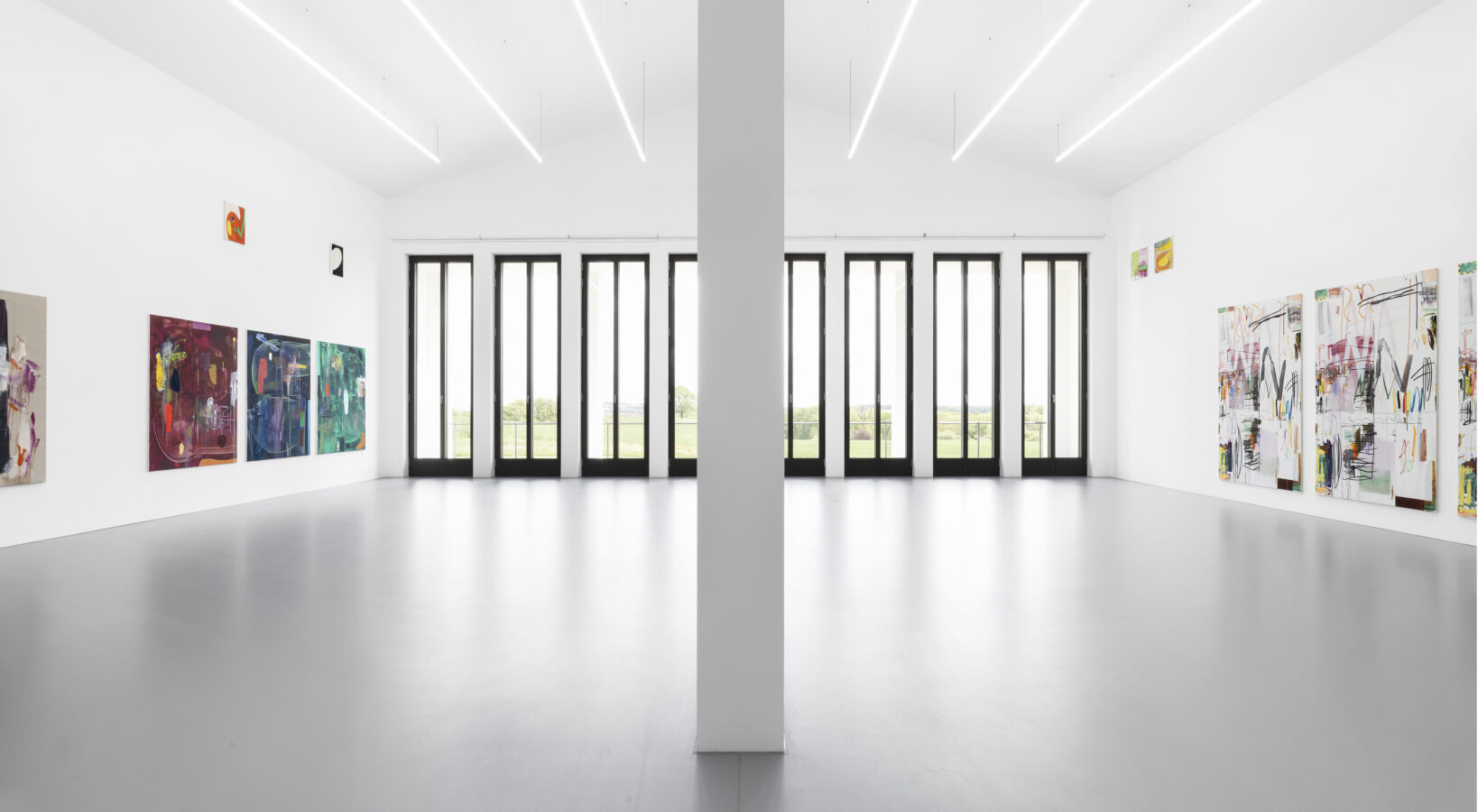
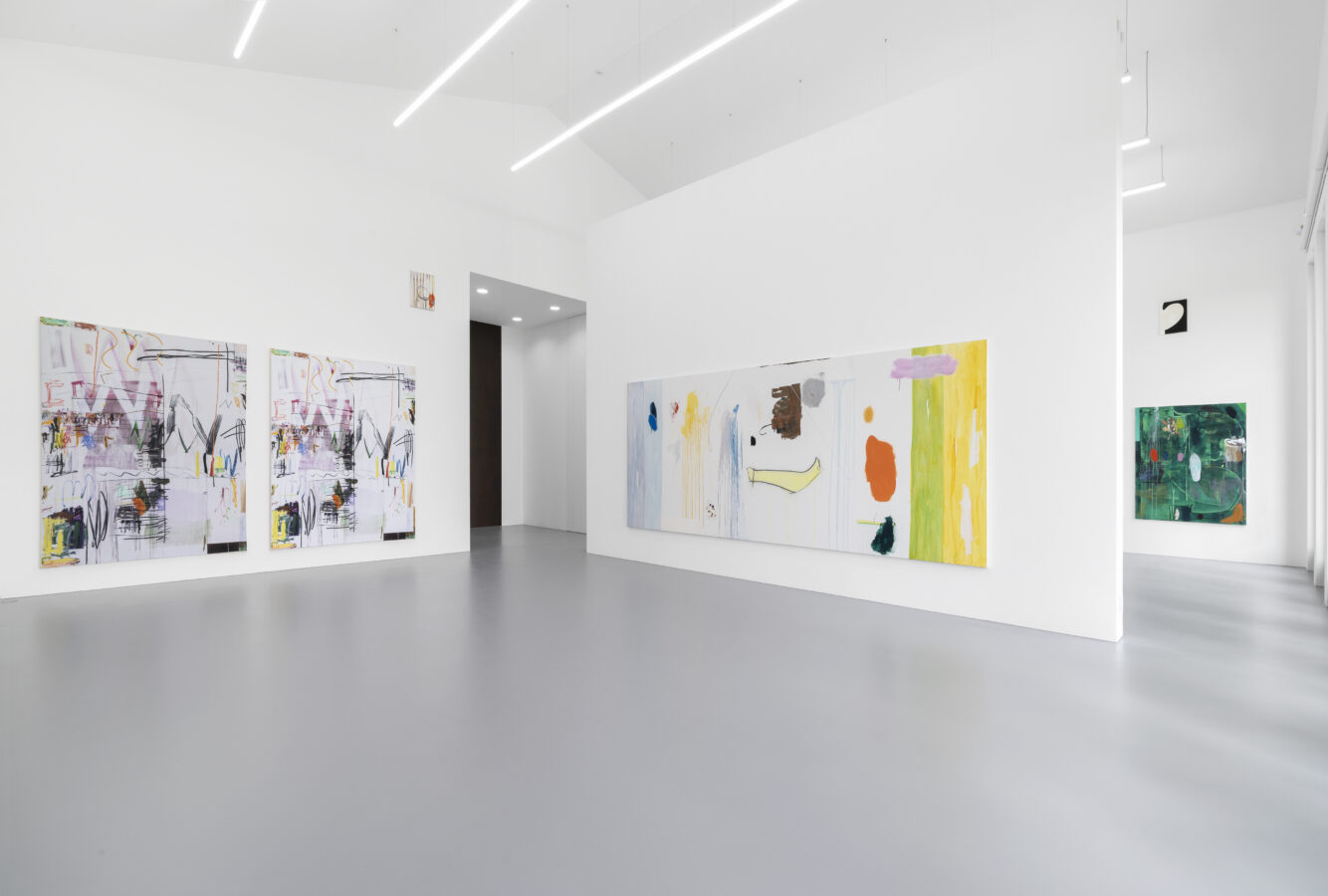
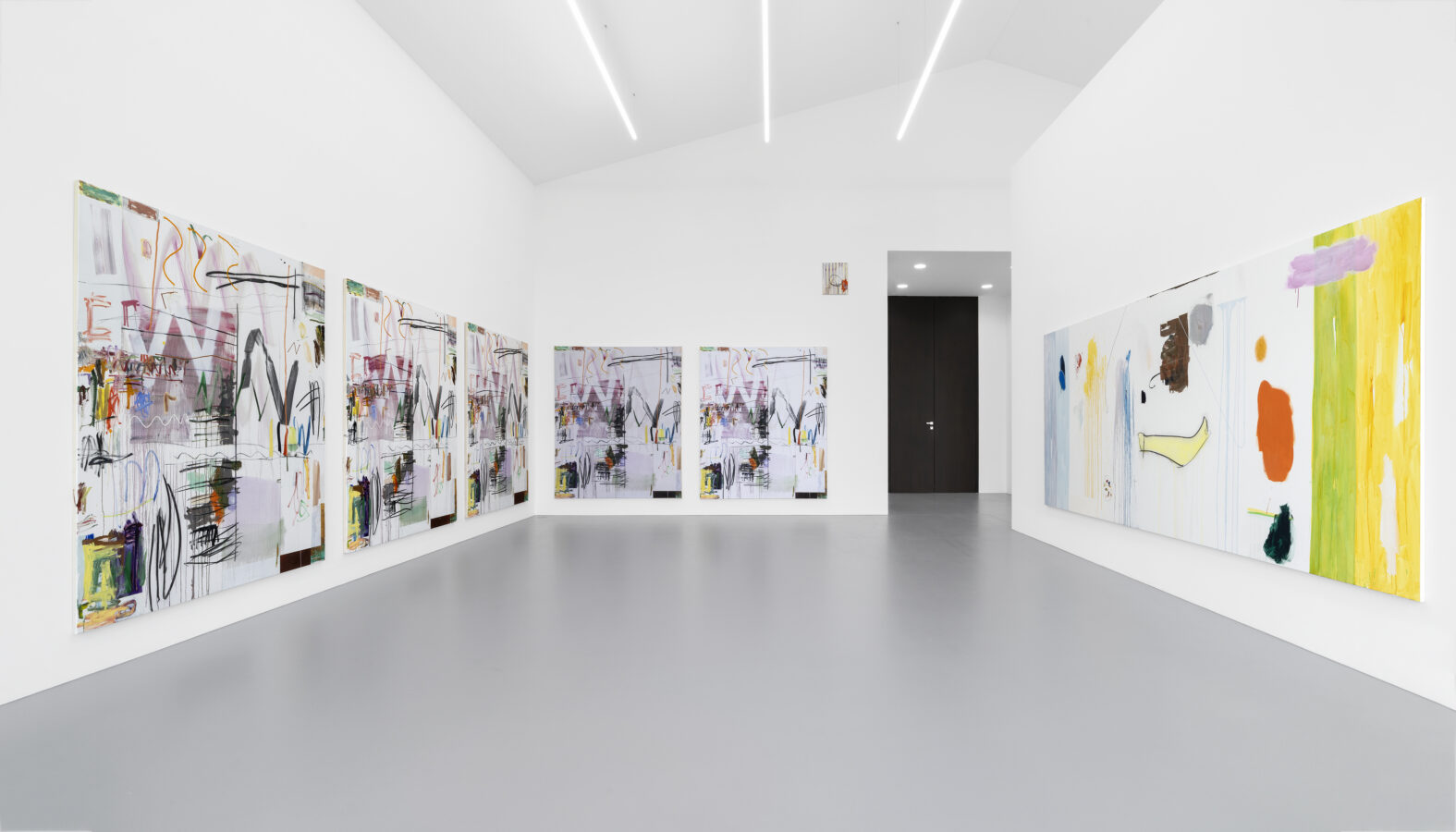
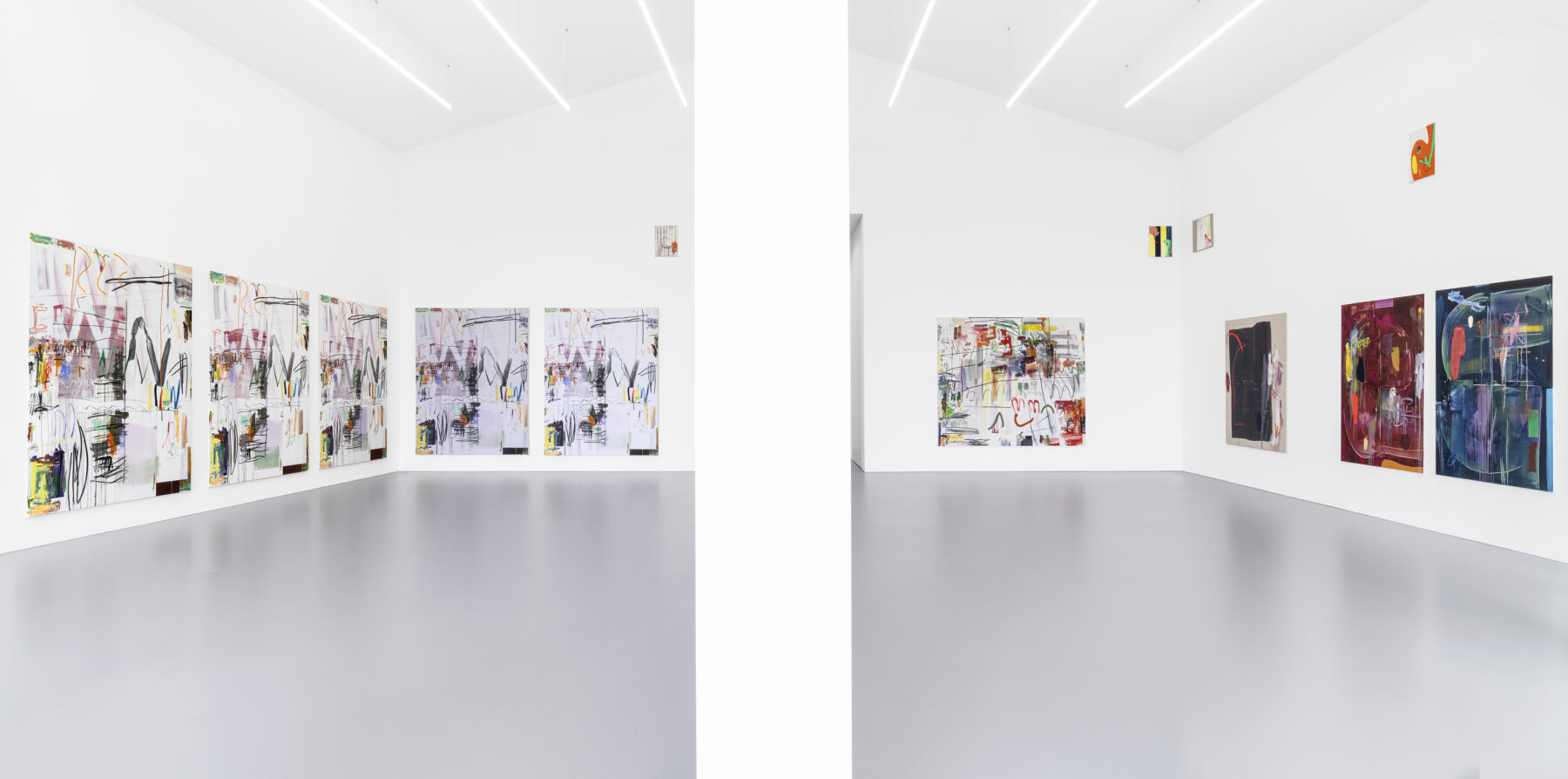
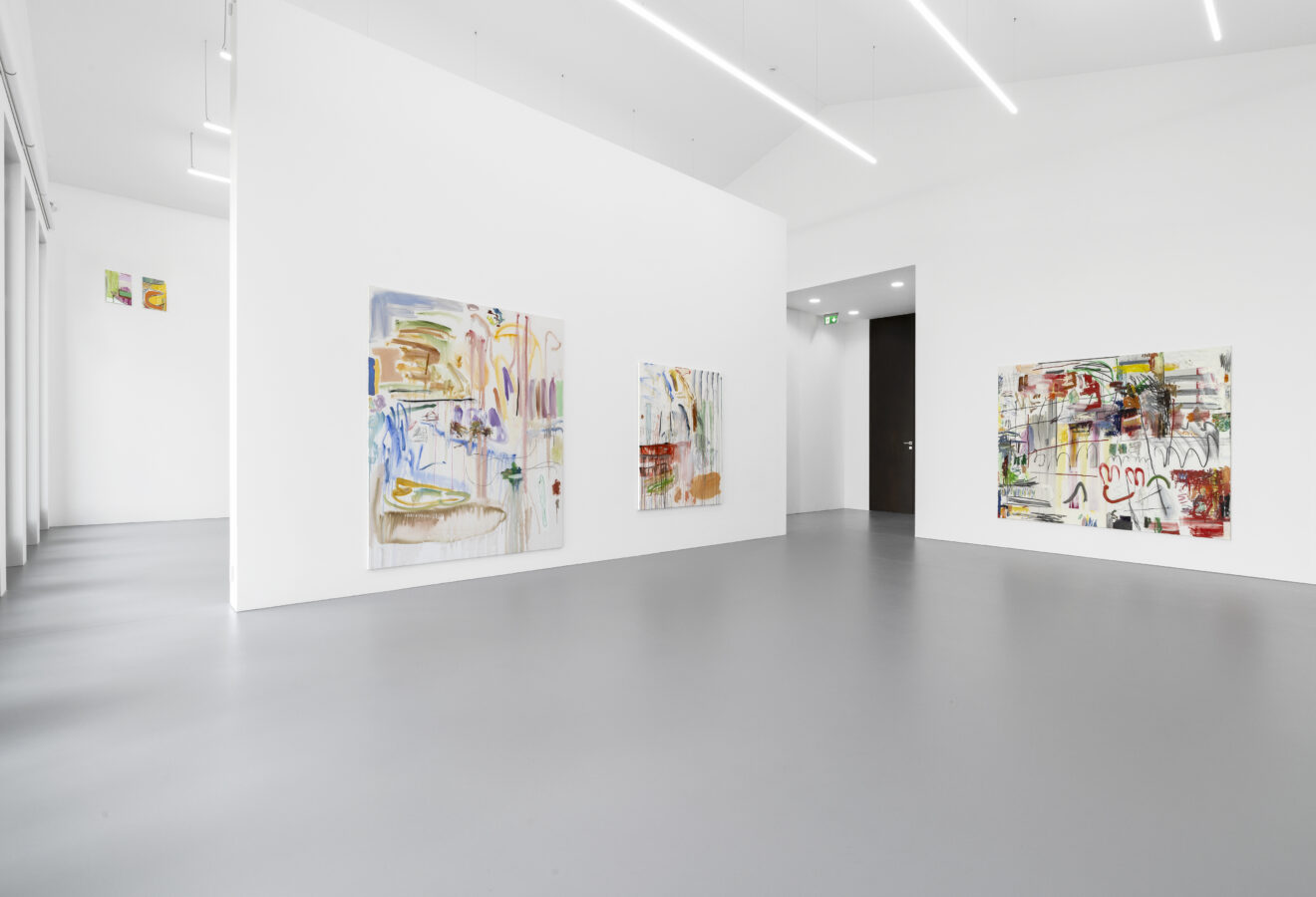
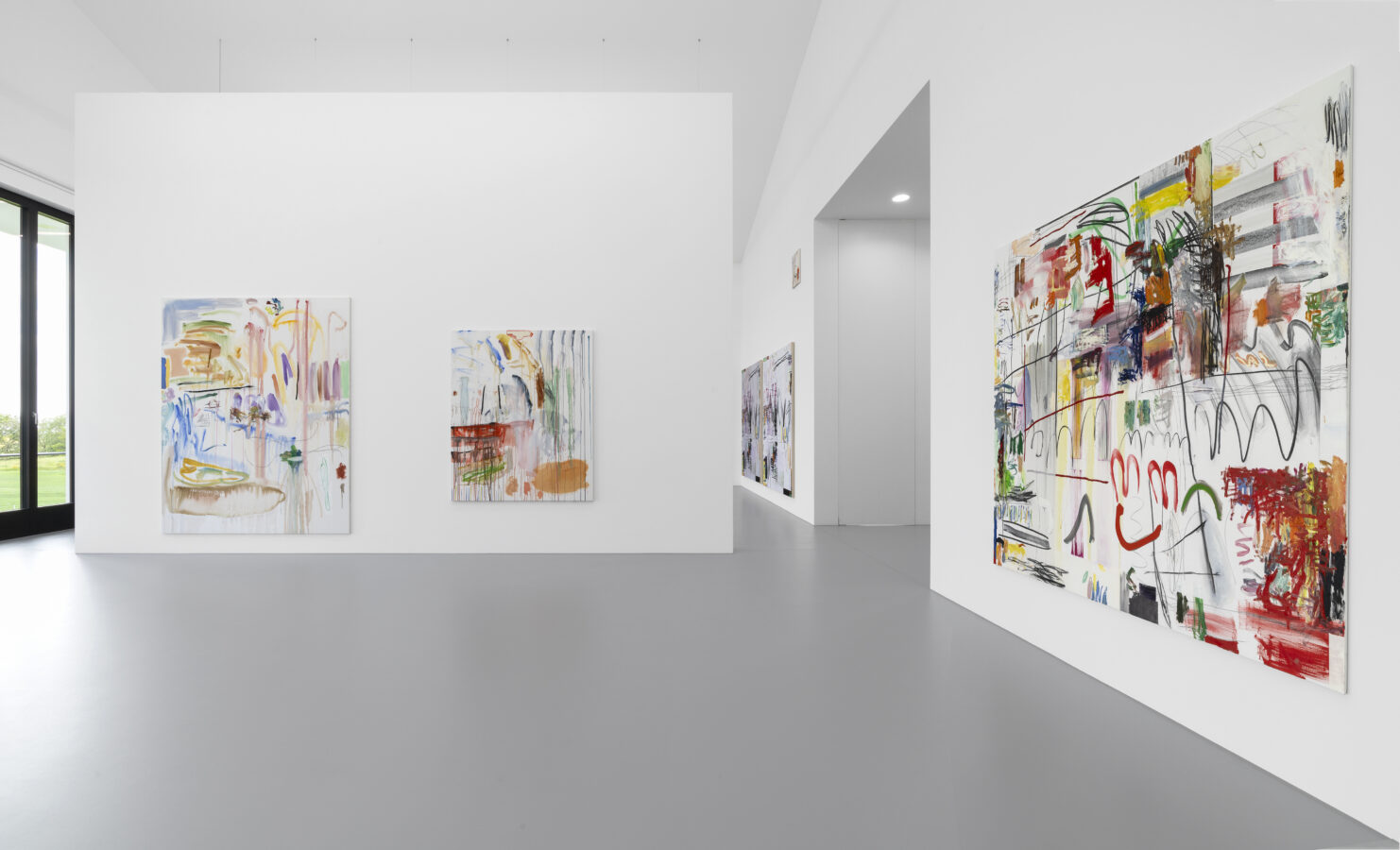
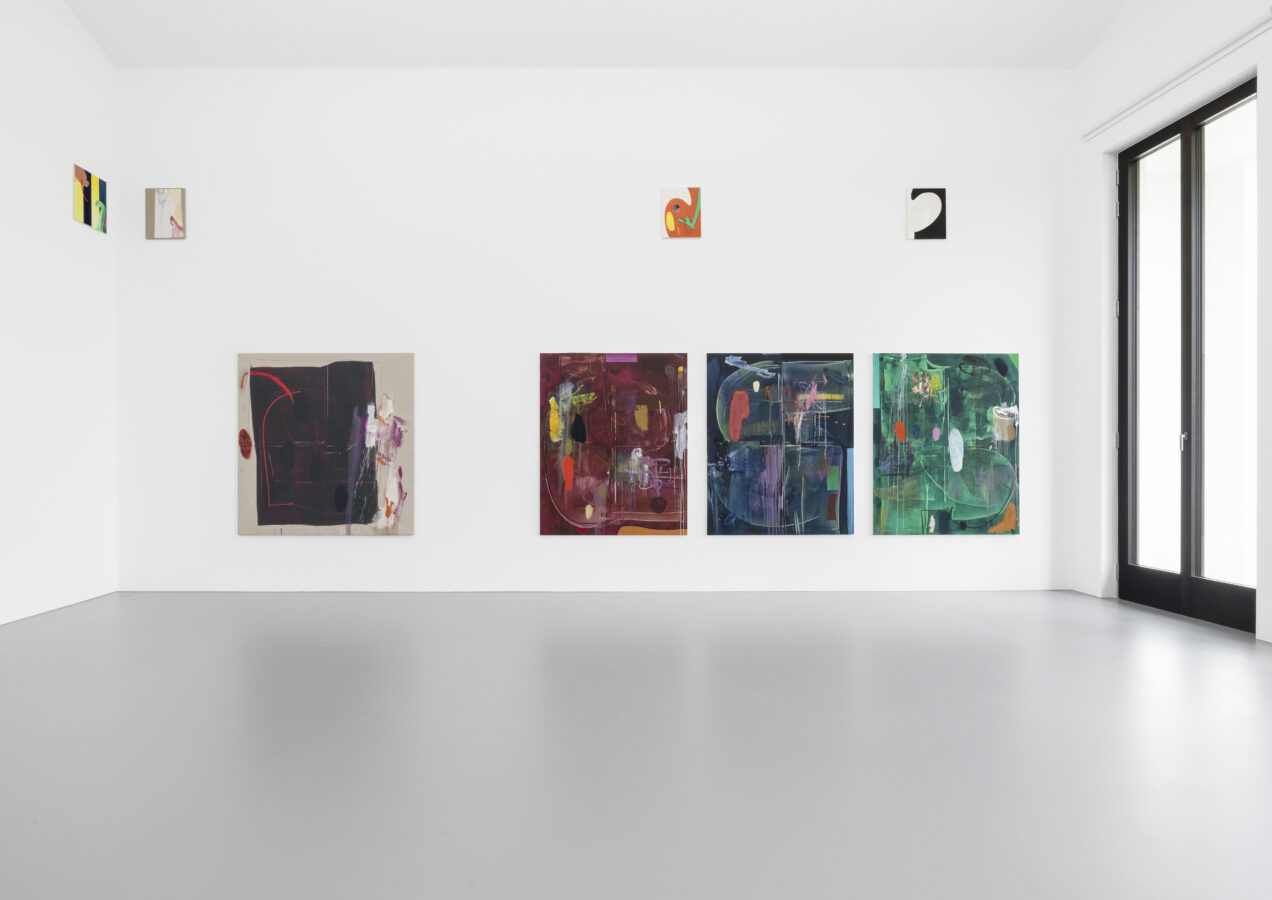
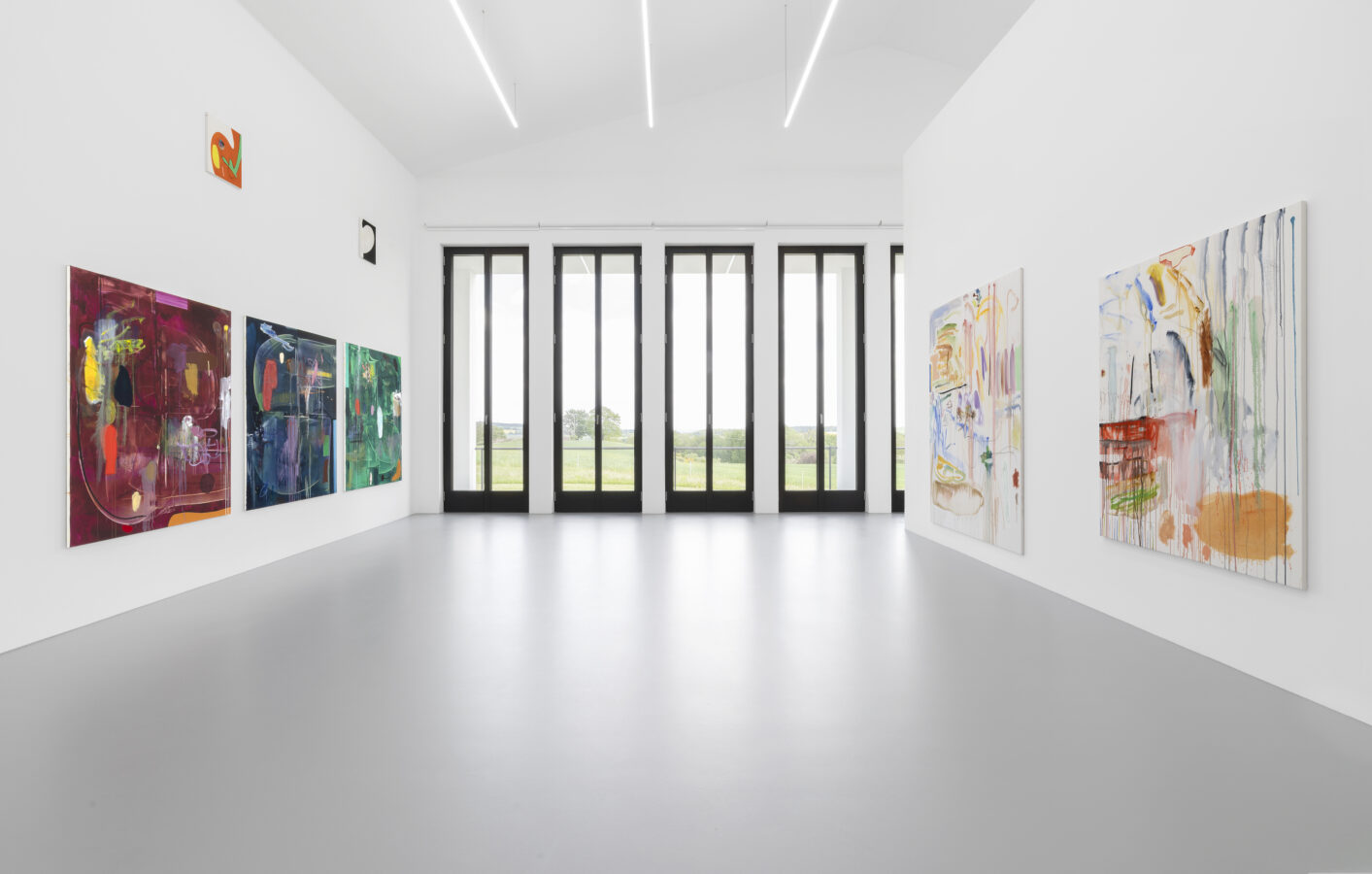
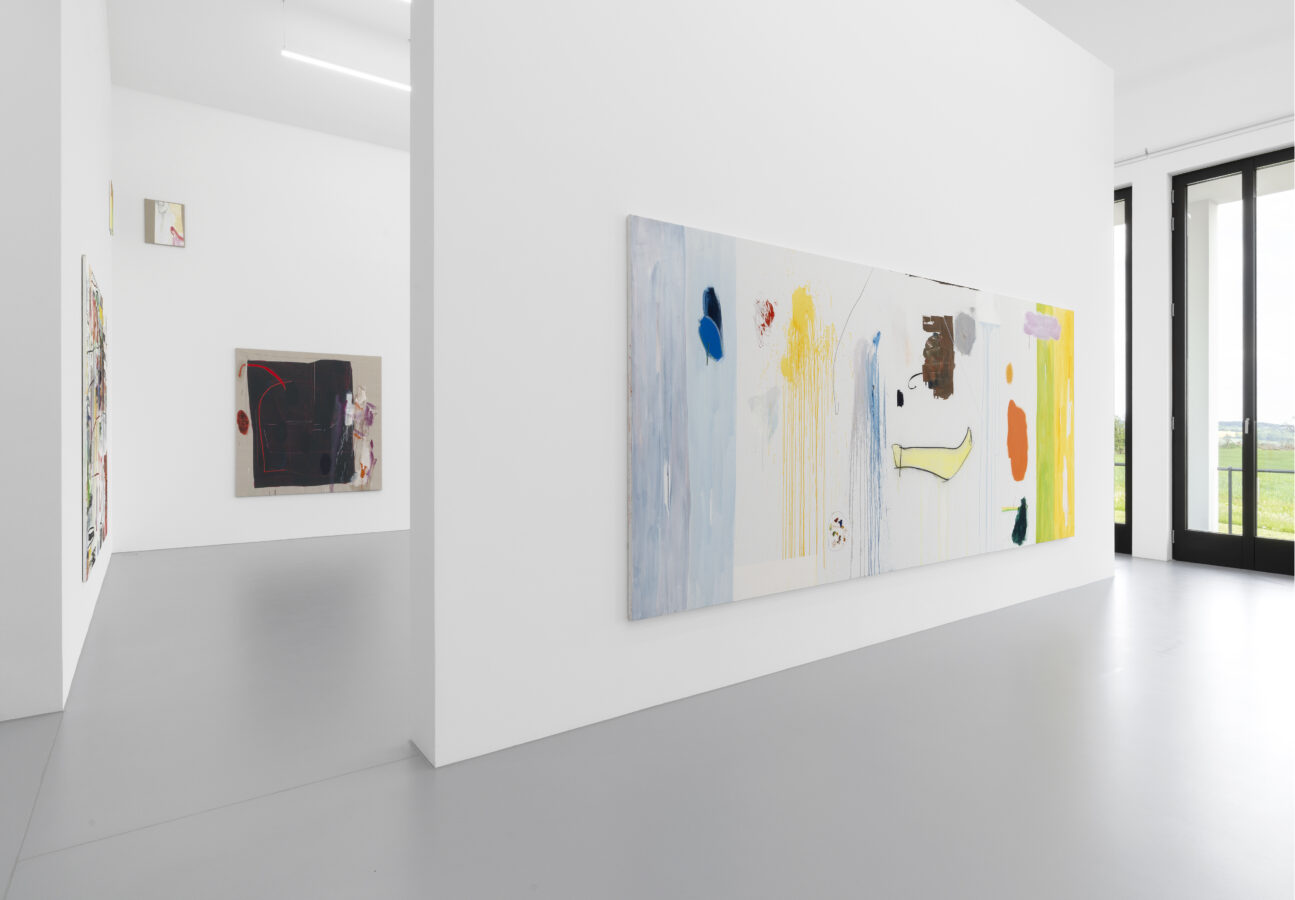
Brunhilde und Günther Friedrichs haben in den vergangenen Jahren einen beachtlichen Werkblock von Dir zusammengetragen. In Weidingen wird nun eine bündige Auswahl aus 2019 und 2025 gezeigt — mit zwei ›Brückenbildern‹ aus 2021. Allerdings nicht als bloße Gegenüberstellung oder Abfolge. In der Ausstellung sind frühe und aktuelle Werke ständig miteinander verschränkt und aufeinander bezogen. Die Unterschiede werden im Gemeinsamen erkennbar und umgekehrt. Kann man das so sagen?
AB
Ja, klar. Wir sprechen allerdings nur über einen äußerst beschränkten Zeitraum von sechs Jahren. Ich arbeite stark prozessual. Eine Werkgruppe führt immer schon zur nächsten. Sobald ein Bildtyp feststeht, bricht er von innen her auf und wandelt sich in etwas anderes. Deshalb mag die scheinbar konträre Zusammenstellung in Weidingen auf den ersten Blick überfordern, aber am Ende hat doch alles miteinander zu tun.
CM
Also verbinden Deine Bilder weniger eine einheitliche Erscheinung als die Methode und Dein Vorgehen?
AB
Genau. Über die vergangenen 20 Jahre habe ich mir eben statt einer ›signature‹ einen bildnerischen Baukasten mit einer ganzen Reihe an Bildmitteln und Ausdrucksmodulen erarbeitet, die je nach Fragestellung unterschiedlich zum Einsatz kommen.
MZ
Das früheste Bild in der Ausstellung und das erste, das Friedrichs erworben haben, ist Hi_LoRes No. 56, 2019. Der Titel verweist wie oft bei Dir auf Digitalität oder digitale Logiken. Deine Bilder hingegen sind stark malerisch und physisch. Eigentlich eine ziemliche Differenz, die Du auf der Leinwand offen ausstellst. Worum geht es Dir mit der Verbindung des Digitalen und des Malerischen?
AB
Wie schon gesagt, erstmal ist da die biografische Prägung. Meine Generation ist die letzte, die vordigital aufgewachsen ist, zumindest nicht seit Geburt. Die Veränderungen und Umwälzungen in Kommunikation, Informationsaustausch und so weiter waren in den späten 1990ern und frühen 2000ern enorm. Facebook wurde am 4. Februar 2004 gegründet, das war mein 21. Geburtstag. Mich hat schon immer interessiert, wie man mit der physischen, im Vergleich archaischen Sprache der Malerei digital operierenden Systemen und Oberflächen begegnen kann.
MZ
Und warum gerade englische Titel?
AB
Wie schon die ›Weltsprache Abstraktion‹ in den 1950ern spricht auch das Digitale Englisch.
CM
Braucht Malerei einen Gegenwartsbezug?
AB
Kann man so oder so beantworten. Im meinem Fall ganz sicher mit ja. Wie lassen sich die gegebenen Mechanismen neu definieren und umschreiben?
MZ
In Hi-tech minimal No. 1–5, 2019, thematisierst Du die Spannung zwischen der Wiederholung und der möglichen Entleerung der malerischen Geste. Wiederholte, also betonte Bedeutung und zugleich Ausdrucksverlust. Was interessiert Dich an daran?
AB
In der beliebigen Wiederholbarkeit durch digitale Tools wie Photoshop oder InDesign wird nicht nur jedes Bild zum Abbild, jedes Original zur Kopie, sondern sämtliche unserer Begrifflichkeiten und Wahrnehmungskriterien müssen völlig neu definiert werden.
CM
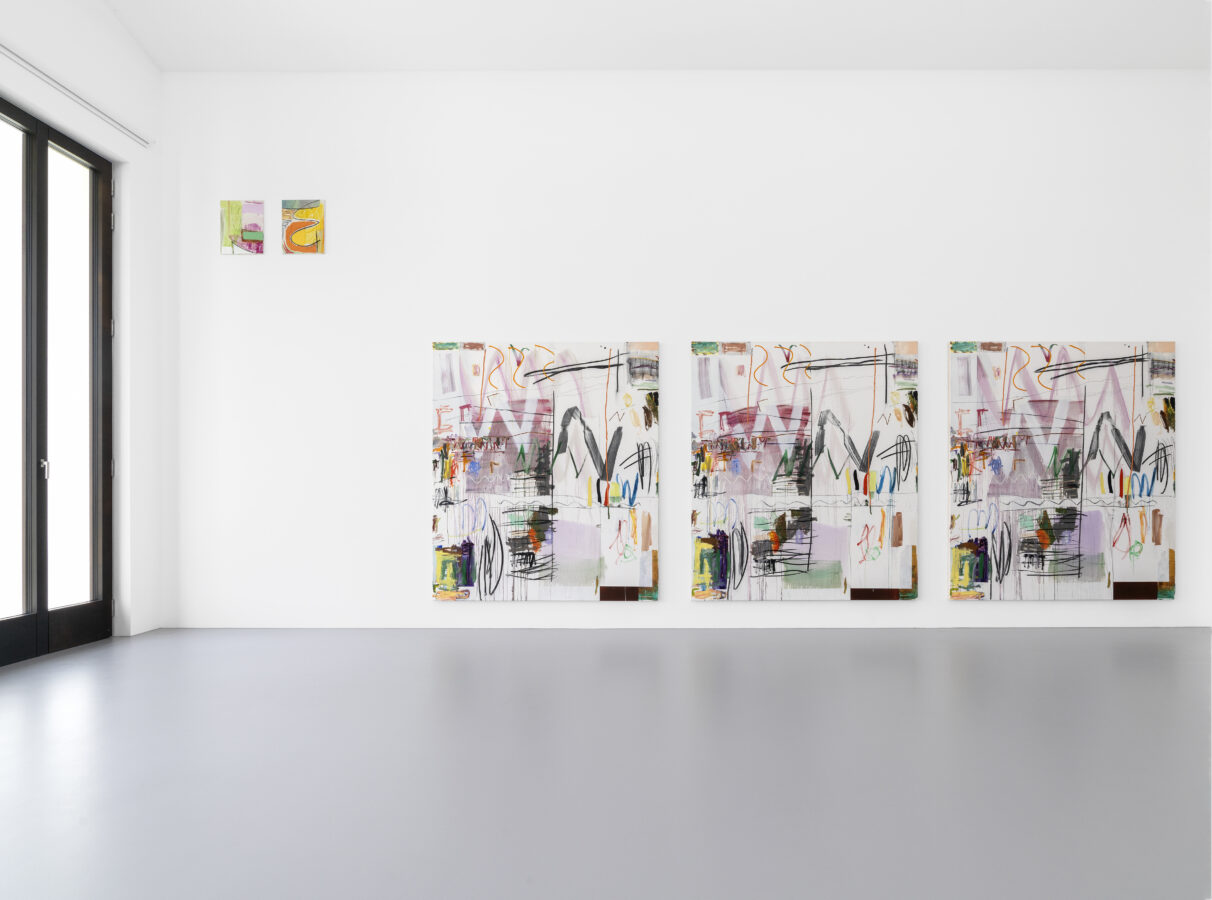
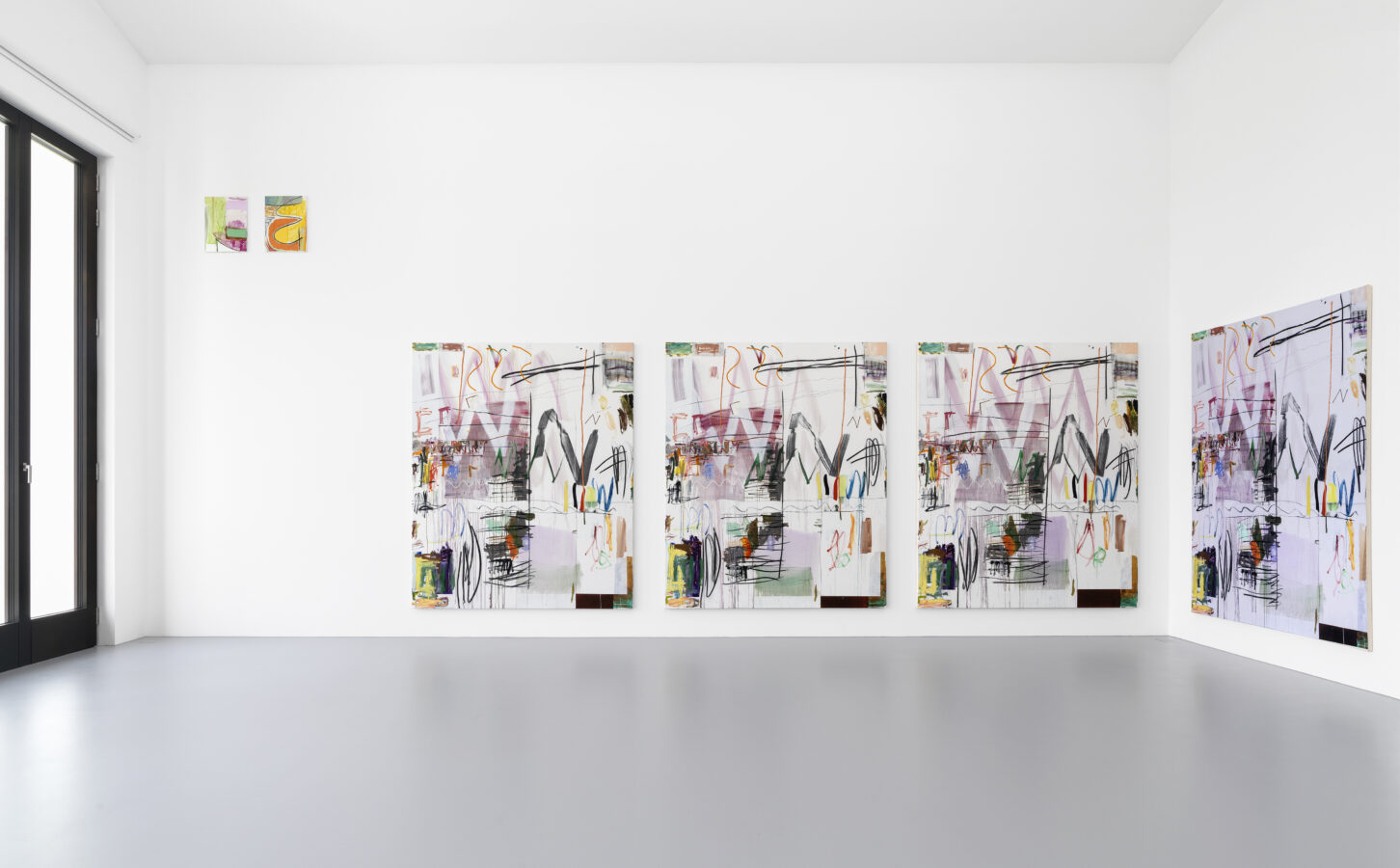
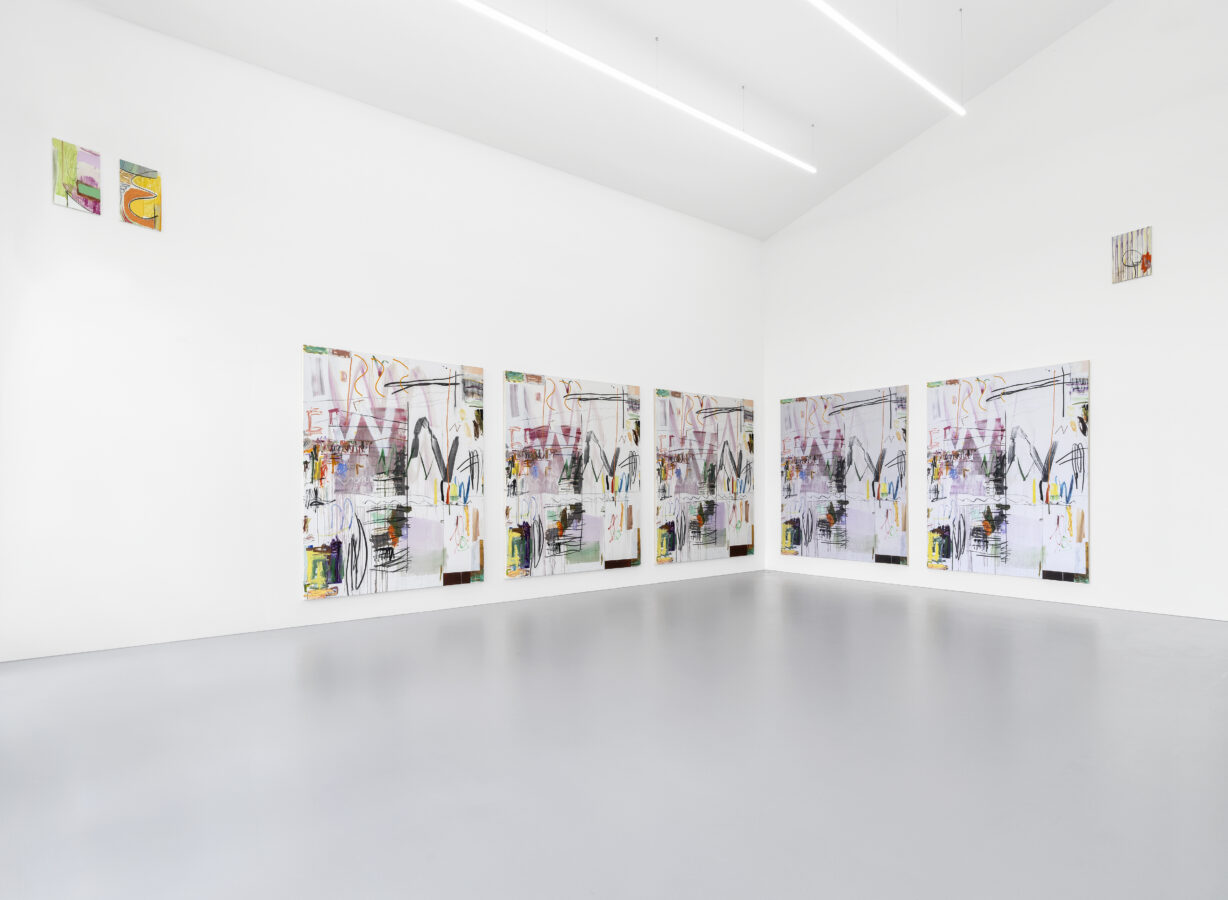
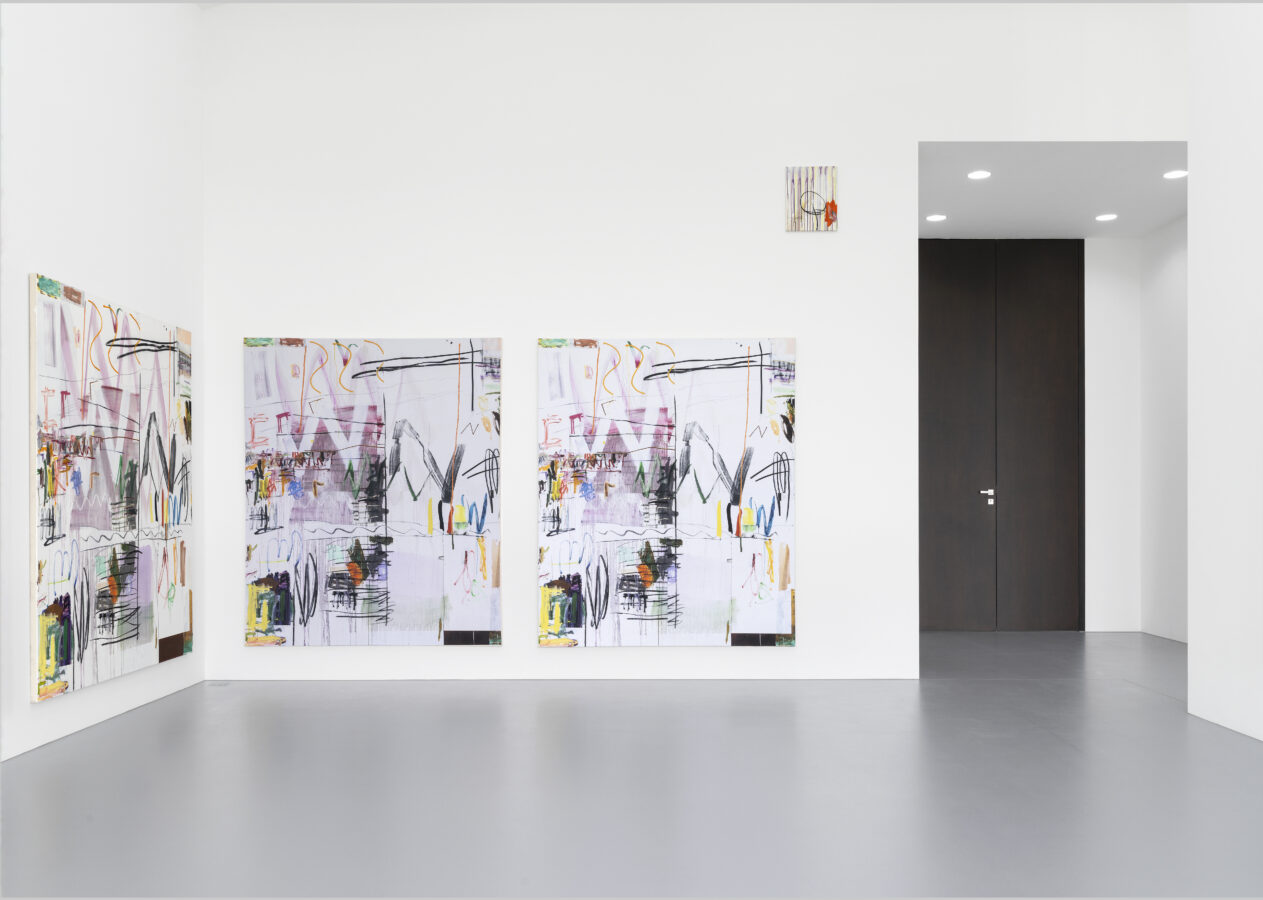
Diese fünf Bilder sind ein absolutes Hauptwerk und der Schlüssel zu Deiner gesamten Bildauffassung und Ästhetik. Mich haben sie immer an Rauschenbergs Factum I und Factum II, beide 1957, erinnert. Von Bild zu Bild überträgst Du so genau wie möglich, wenngleich mit unvermeidlichen Abweichungen, jeden einzelnen Strich, jede Fläche, jede Form. Die beiden letzten Bilder allerdings sind dann Drucke digitaler Reproduktionen — noch stellenweise übermalt in 4 und völlig blank in 5. Problematisierte Rauschenberg das Verhältnis von Vor- und Abbild mit zwei ebenbürtigen Originalen, steigerst Du das Problem um ein Vielfaches. Hebeln Bilder das Wirkliche aus?
AB
Was ist ein Bild? Was das Wirkliche? Ich habe ja kein Original mehr. Jedoch auch keine Kopie. Jedes der fünf Bilder ist beides zugleich. Derartige Gleichzeitigkeit und Ambivalenz sind es, die mich interessieren.
MZ
Dabei scheint Dir Ordnung sehr wichtig zu sein, besonders in der Art, wie Du Deine Bild- und Serientitel strukturierst und systematisierst. Das steht konträr zur expressiven, gestischen Qualität deiner Malerei. Wie hängen die beiden Pole für Dich zusammen?
AB
Ich würde behaupten, dass meine Bilder ebenso strukturiert und systematisch sind. Selbst wenn die Bildmittel es nicht zu sein scheinen.
CM
Sind die Bilder überhaupt expressiv? Oder rufen sie vielmehr Expressivität als Erscheinungsmodus von Malerei auf?
AB
Sie simulieren eine Oberfläche. Und diese Oberfläche an sich ist neutral, deutungsoffen.
CM
Bei näherer Betrachtung erscheinen die Gesten, Strichbündel und Flächen auf jedem Gemälde isoliert oder fragmentiert. Die Fläche ist offen, wird aber oft von den Seiten her umgrenzt und eingefasst. Hat das Bildfeld für Dich etwas von einer Versuchsanordnung?
AB
Unbedingt. Im unwahrscheinlichsten Fall ist ein Bild eine Beweisführung. Am Ende ist mir womöglich nicht mal wichtig, dass Malerei draus wird.
MZ
Du verwendest seit Jahren in jedem Bild dieselben Materialien: Öl, Acryl, Kohle und Graphit auf Leinwand. Wieso?
AB
Reduktion vs Maximierung. Ich reduziere die Informationen auf der Oberfläche, aber maximiere das Material.
CM
Materialität statt Substanz? Oder ist die Frage zu metaphysisch?
AB
Vielleicht speist sich Substanz nicht aus der Materialität?
CM
Du hast mal davon gesprochen, dass Deine Bilder ›apparativ‹ wären. Was heißt das?
AB
Ein Rädchen greift ins andere … Meine Bilder bestehen eher aus vereinzelten Bausteinen oder Partikeln als aus zusammenhängenden Abfolgen. Wenn überhaupt, gibt es vielleicht Cluster, die eine Arbeit ausmachen. Selbst die Konzeptionen meiner Ausstellungen, deren Gesamt- oder Großstruktur funktionieren auf dieselbe Weise.
CM
Du hast auch gesagt, dass es Dir in Deinen Bildern um den Austausch und die Verarbeitung von Informationen geht. Nur was für Informationen?
MZ
Biologie, Chemie, Mykologie, Soziologie, Linguistik, Informatik.
CM
Daher?! Warum?
AB
Kann alles sein. In einer post-digitalen, höchst selektiven Aufmerksamkeitsökonomie geht es mir hauptsächlich um den Austausch und die Verarbeitung von Informationen an sich.
CM
Keine Motive, nur Problemstellungen?
AB
Geht’s nicht immer um Probleme?! Und mögliche Lösungen …
CM
Kannst Du im Gegensatz dazu etwas zu Deinen künstlerischen Einflüssen und Bezügen sagen?
AB
Ich könnte jetzt Namen aufzählen, aber macht das Sinn? Sobald die Fundamente da sind, auf denen man stehen will, ist doch alles Einfluss.
MZ
Um auf die Ausstellung zurückzukommen, welche Rolle spielen Sort Cuts No. 33 und 40, 2021?
AB
Beide sind ein Übergang. Sehr große Rolle!
CM
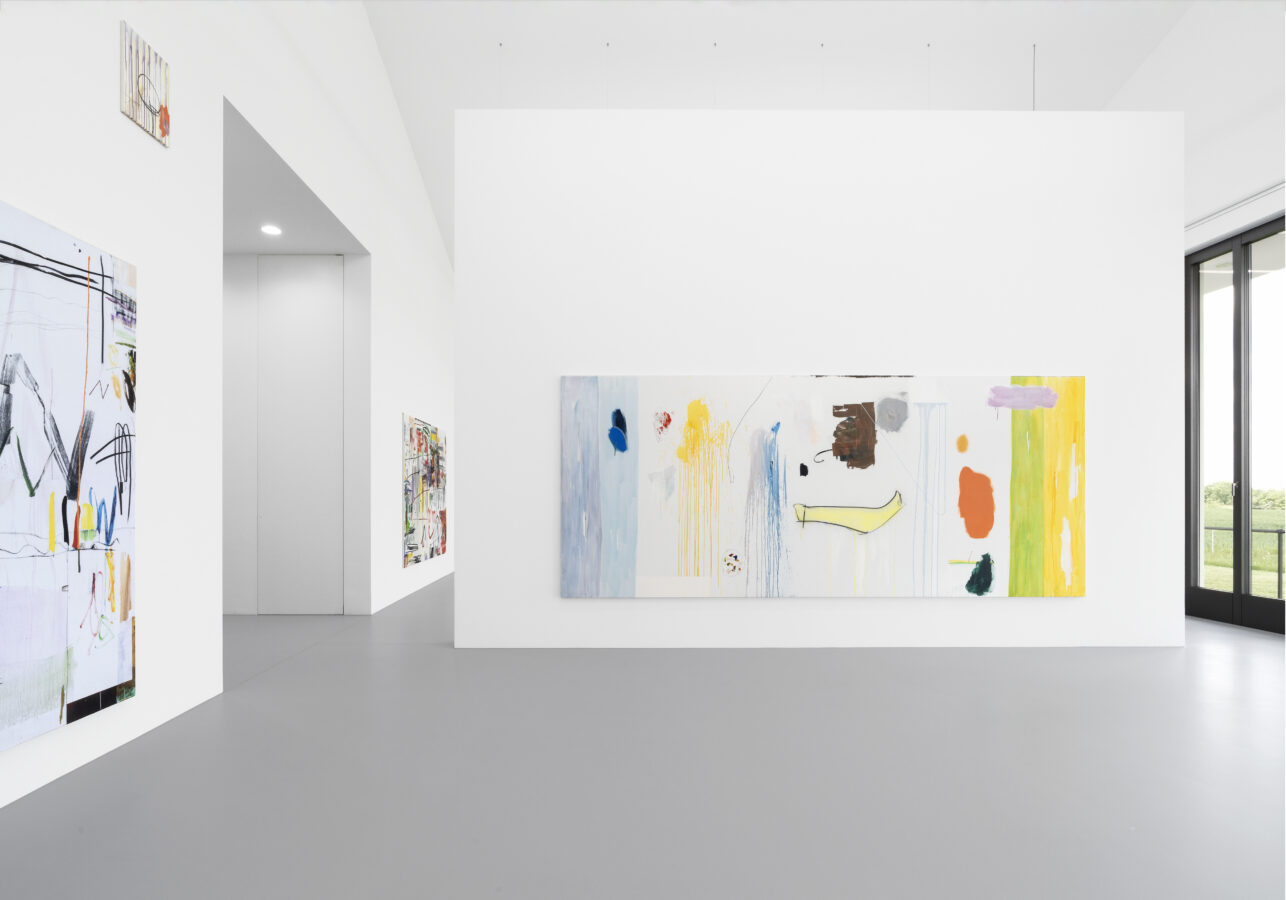
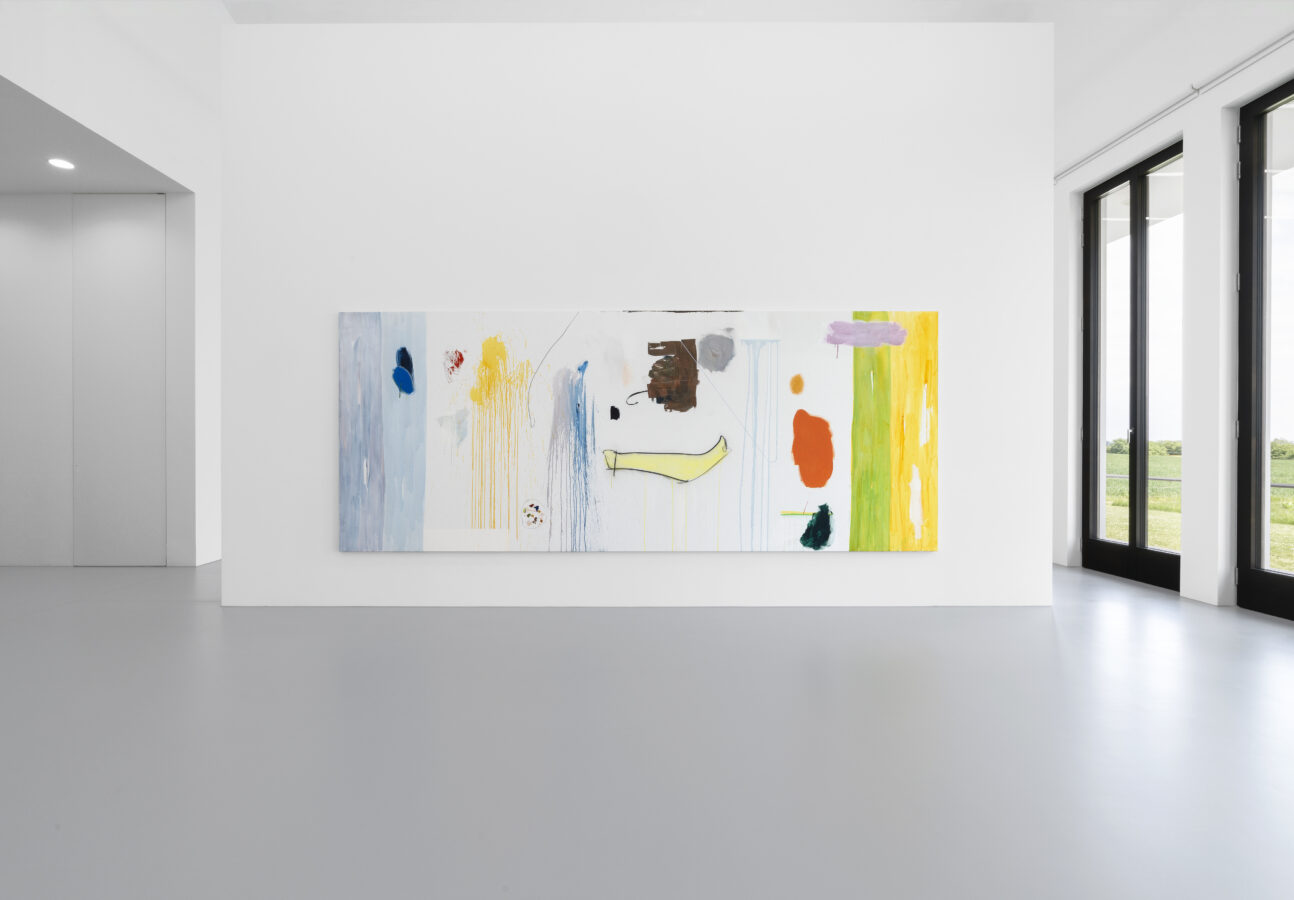
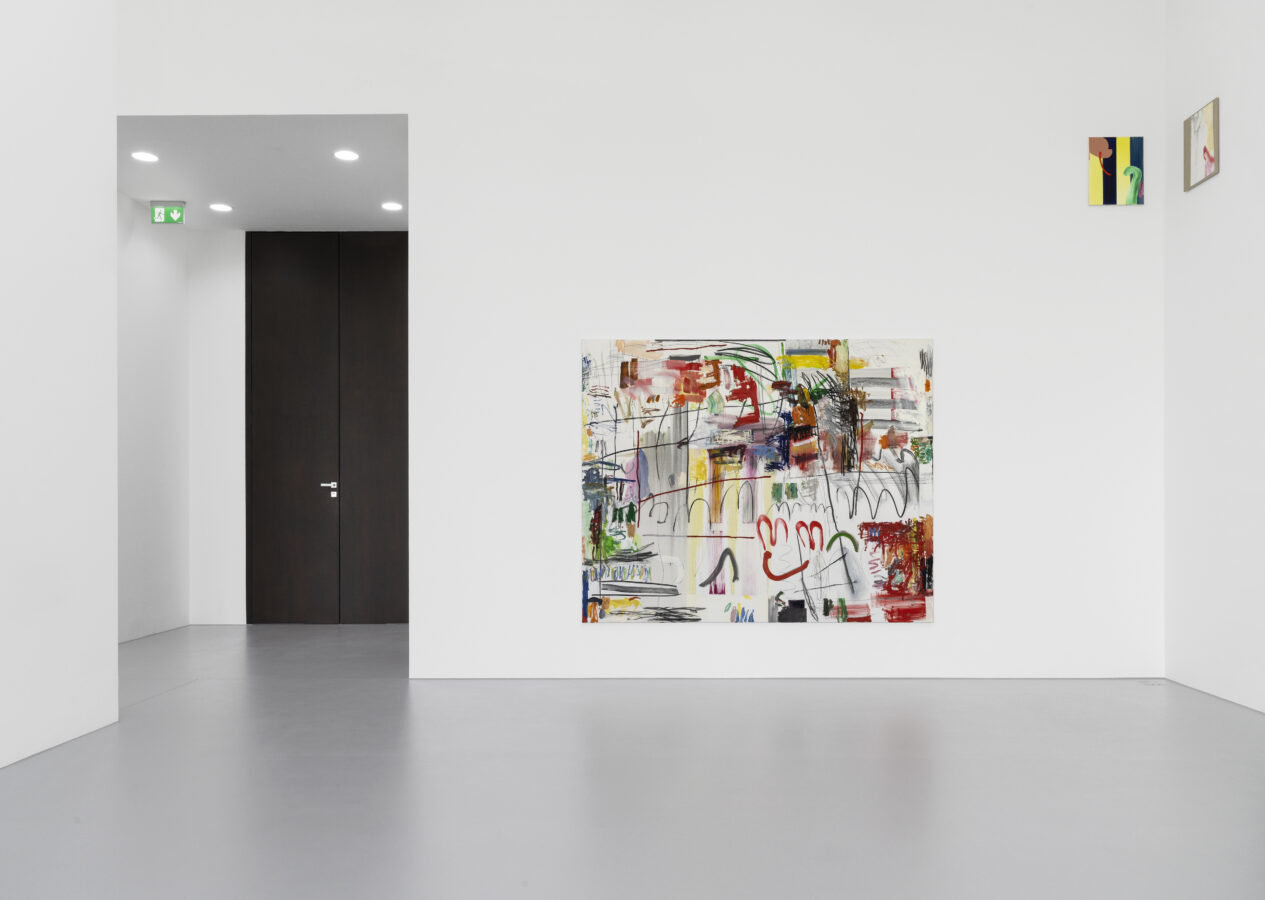
Die jüngsten Bilder in der Ausstellung sind dann Consequential Damage No. 02, 05, 07 und 10, sowie das monumentale Discourse Analysis No. 02, alle 2025. »Diskursanalyse« ist Foucault — Sprache bestimmt Wissen und Denken und so fort —, aber »Folgeschäden«?
AB
›Unausweichlicher Schaden‹ würde mir als Übersetzung besser gefallen … Die Idee kommt aus einem Bruch in meiner Arbeit, den ich mir mit der Prediciton / Analysis-Serie herbeigemalt habe. Zum einen war die Überlegung, wie die Antwort auf diese weit offene Frage aussehen könnte. Zum anderen rein künstlerisch, wie man ausgehend von absoluter Reduktion dennoch weitermalen kann.
MZ
Sind Deine Bilder Analysen und Untersuchungen und zugleich Neubestimmungen der Sprache der Malerei?
AB
Zumindest ein Versuch davon. Überlieferte sprachliche Kategorisierungen funktionieren im Post-Digitalen nur noch bedingt. Also braucht man eine neue sprachliche Grundlage. Um diese zu schaffen, muss man seine Sehgewohnheiten oder besser Automatismen neu schärfen. Und da sind wir noch nicht mal beim Einfluss von KI auf unser Sehen und Denken.
MZ
Das ist aber nicht die ganze Ausstellung. Es gibt noch ein paar Gemälde mehr.
CM
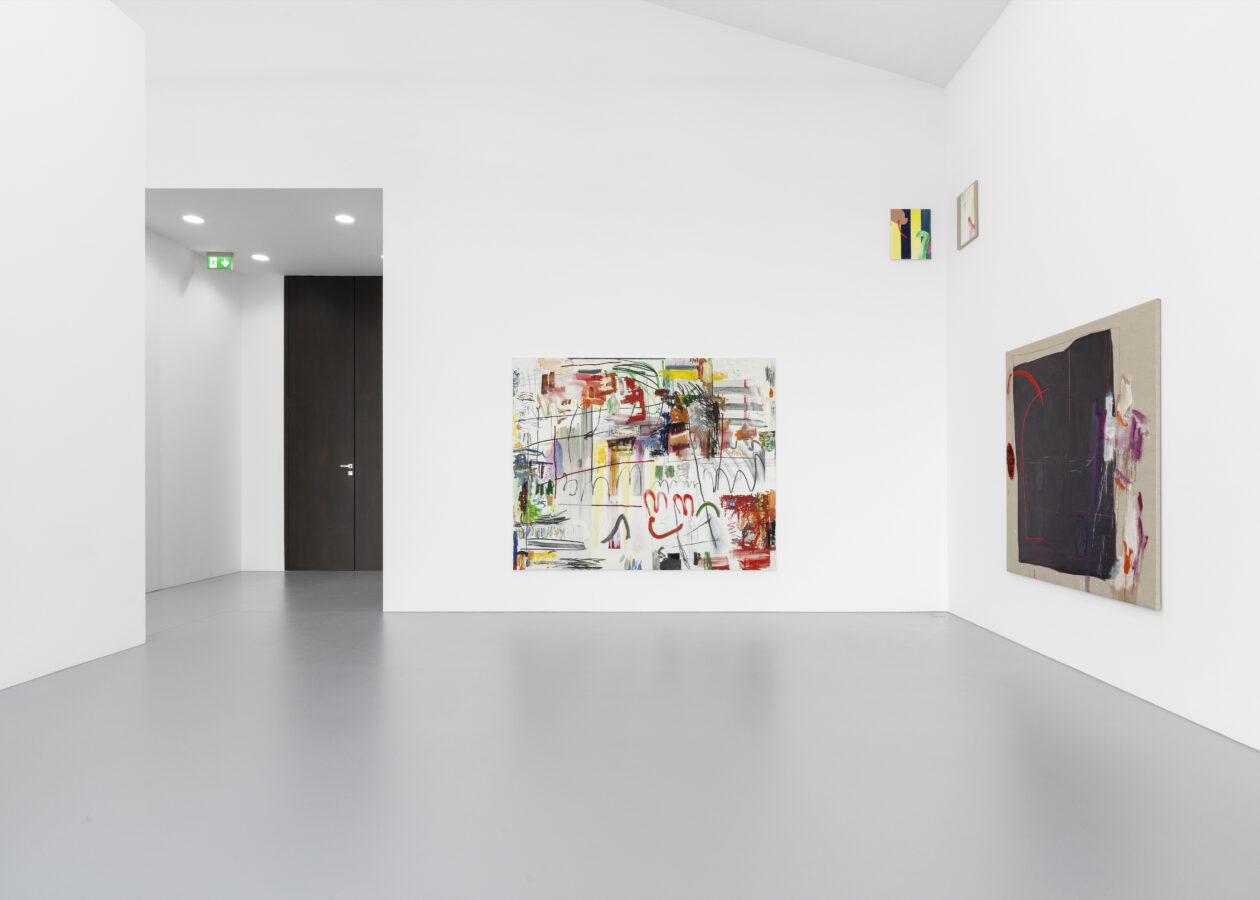
In den Wochen vor der Eröffnung hast Du noch sieben kleinformatige Bilder gemalt: thumbnails ff integrated.
MZ
Die Titel haben alle einen Zusatz: EXTANT (extended), Body Positivity, E.R.P., E.C.P., Underpressed Painting, Protest Paintings / Miller-Urey Paintings und Prediction / Analysis. Alles Serien, die nicht in Weidingen gezeigt werden.
CM
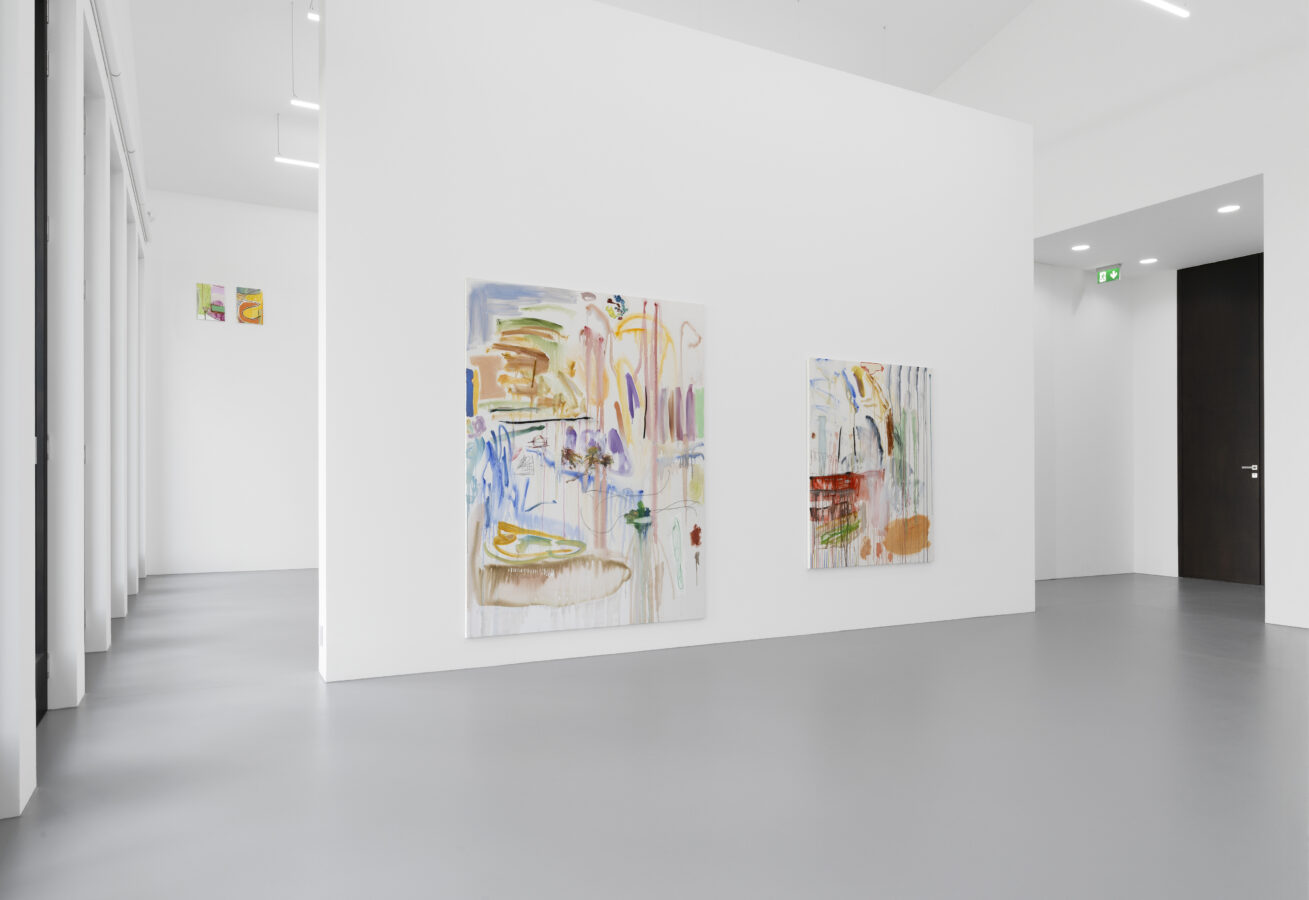
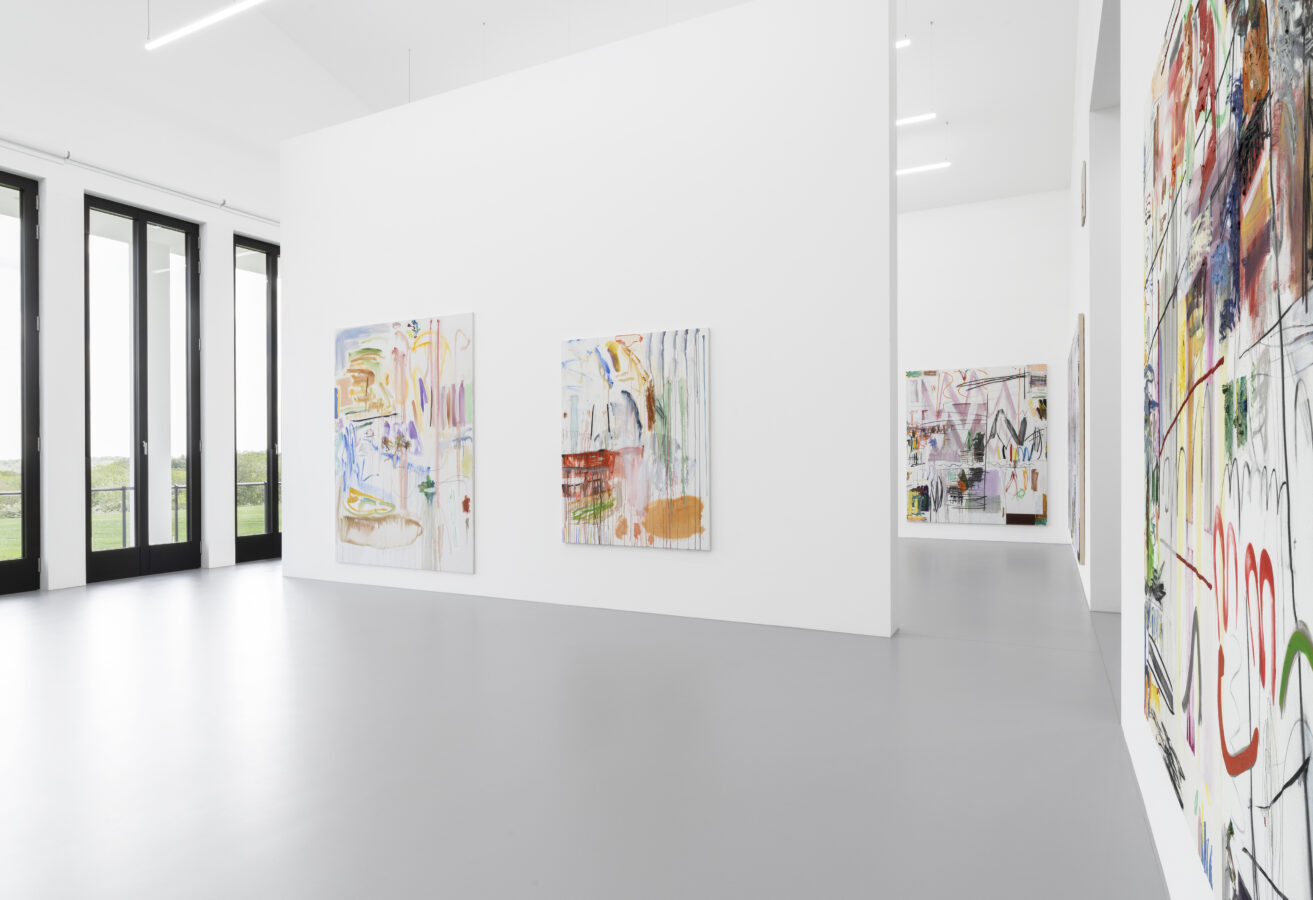
Ich denke mal, thumbnail = Miniatur, ff = Friedrichs Foundation und integrated = doch noch gezeigt … Diese thumbnails sind wie ein Fries mit unregelmäßigen Intervallen in 4m Höhe über die eigentliche Ausstellung gehängt. Fußnoten, Anmerkungen, Ergänzungen? Kommentierst Du Dich selbst?
AB
Das ist es doch!
MZ
Die thumbnails sind ja keine bloße Störung, sondern eine Ausstellung zweiter Ordnung. Anstelle die Bilder von 2019 und 2025 isoliert zu präsentieren, führst Du durch Deine kontextuell-konzeptuellen Selbstzitate subtil die prozessuale Selbstreferenzialität Deines Werkes wieder in die spezifische Ausstellungsituation ein.
AB
Hier sind wir wieder bei der Analyse des eigenen Denkens. Durch die Ausblendung bestimmter Schritte im Werk, schien es mir, dass gewisse Fragestellungen in der Ausstellung nicht zwingend genug formuliert und damit nachvollziehbar waren. Also mussten die noch sichtbar werden.
MZ
Ein Freund klassisch gehängter Ausstellungen bist Du ja ohnehin nicht. Warum bevorzugst Du solch installative Displays?
AB
Reine Aufmerksamkeitsökonomie. Und außerdem male ich ja keine Tafelbilder …
Andreas Breunig im Gespräch mit Christian Malycha und Marisa ZeisingMZ
Have you always wanted to be a painter?
AB
Right from the start, I couldn’t think of anything better.
CM
You studied in Düsseldorf under Albert Oehlen from 2002 to 2008. Conscious decision or coincidence?
AB
Studying at the Düsseldorf Academy was a conscious decision. It was an amazing group of people teaching there back then.
CM
Not only was this an extraordinarily fruitful moment in time at the academy, but particularly in Albert’s class, fundamental questions about painting were being asked anew and re-examined—Duchamp, Warhol, Polke, the Pictures Generation, authenticity, appropriation, and reproducibility … You couldn’t find that anywhere else.
AB
Agreed. There were other schools with different areas of expertise but when it came to painting, Düsseldorf was exceptional. Once I actually arrived there, I realized pretty quickly that for me the discourse with Albert and in his class was by far the most interesting.
MZ
What are your general thoughts on painting?
CM
Beuys’ »The mistake begins the moment someone sets out to buy stretchers and canvas.« and Immendorff’s »Stop painting« are also Düsseldorf …
MZ
… so, what keeps you painting? What opportunities does it offer, you wouldn’t find elsewhere?
AB
Painting is absolutely direct. Action and result are immediately present. I neither had enough time nor patience for anything else. Besides, in the early 2000s it seemed only logical to me to explore how digitality could be integrated into painting. Especially when, like me, you come from that flawed transitional generation that categorically rejects everything ›classic‹, yet is still imprinted by the exposure to traditional media.
CM
Brunhilde and Günther Friedrichs have collected a substantial group of your work over the past few years. A concise selection from 2019 and 2025 is now on display in Weidingen—along with two transitional paintings from 2021. However, this is not merely a juxtaposition or a chronological sequence. In the exhibition, early and recent works are constantly interlocked and related to one another. Their differences become apparent in what they commonly share, and vice versa. Is that accurate?
AB
Yes, of course. Still, we’re just talking about a limited period of six years. My work is very procedural. One group of works always leads to the next. As soon as one type of image is established, it cracks open from within and transforms into something else. That’s why the seemingly contradictory constellation in Weidingen might seem overwhelming at first glance. But after all, everything is connected.
CM
Is it the method then or your approach that tie your images together, rather than a consistent visual style?
AB
Exactly. Over the past 20 years, rather than developing a ›signature‹, I’ve assembled a pictorial toolkit consisting of a whole range of visual elements and expressive modules, which I employ in different ways depending on the issue at hand.
MZ
The earliest painting in the exhibition and the first one Friedrichs acquired is Hi_LoRes No. 56, 2019. As is often the case with your work, the title refers to digitality or digital logics. Your paintings, on the other hand, are highly painterly and physical. In fact, that’s a stark contrast, one that you openly enact upon the canvas. What are you trying to achieve by splicing the digital and the painterly?
AB
As I said, biography context comes first. My generation is the last to have grown up in the pre-digital era, at least not from birth. The changes and upheavals in communication, information exchange, and so on were enormous in the late 1990s and early 2000s. Facebook was founded FEB 4, 2004—my 21st birthday. I’ve always been interested in how to engage with the physical, comparatively archaic language of painting in the context of digitally operating systems and interfaces.
MZ
And why English titles, of all things?
AB
Just like abstraction as a global language did in the 1950s, the digital speaks English.
CM
Does painting need to have a connection to the present?
AB
You can answer that either way. In my case, the answer is definitely yes. How to re-define and re-phrase the given mechanisms?
MZ
In Hi-tech minimal No. 1–5, 2019, you problematize the tension between repetition and the potential deflation of the painterly gesture. Repeated and thus emphasized meaning, yet at the same time a total loss of expression. What fascinates you about it?
AB
Considering the unlimited reproducibility made possible by digital tools such as Photoshop or InDesign, not only does every image become a reproduction and every original a copy, but all of our concepts and criteria for perception must be completely re-evaluated.
CM
Those five paintings are an absolute key piece and the epitome to your entire pictorial thinking and aesthetic. They have always reminded me of Rauschenberg’s Factum I and Factum II, both 1957. From one painting to the next, you reproduce as precisely as possible, albeit with inevitable deviations, every single line, every plane, every shape. The last two images, however, are prints of digital reproductions—still partially over-painted in 4 and completely plain in 5. While Rauschenberg problematized the relationship between the original and its copy by means of two equally valid originals, you amplify the problem many times over. Do images negate reality?
AB
What’s an image? What is reality? No longer do I have an original. Nor a copy. Each of the five paintings is both at the same time. It’s this kind of simultaneity and ambivalence that interests me.
MZ
You seem to care about order, specifically in the way you structure and organize the titles of your paintings and series. This stands in contrast to the expressive, gestural quality of your painting. How do these two poles relate to each other for you?
AB
I would argue that my paintings are just as structured and systematic. Even if the pictorial elements don’t seem so.
CM
Are the paintings even expressive? Or do they rather evoke expressiveness as one painterly mode of appearance?
AB
They simulate a surface. And this surface in and of itself is neutral, open to interpretation.
CM
Upon closer inspection, the gestures, clusters of brushstrokes, and planes in each painting appear isolated or fragmented. The color field is open, yet it is often bounded and framed from its sides. Does this strike you as something of an experimental setup?
AB
Absolutely. In the most unlikely scenario, a painting is a line of reasoning. In the end, it might not even matter to me whether it turns into a painting.
MZ
You’ve been using the same materials in every painting for years: oil, acrylic, charcoal, and graphite on canvas. Why?
AB
Reduction vs. maximization. I reduce the amount of information on the surface but maximize the material.
CM
Materiality instead of substance? Or is this question too metaphysical?
AB
Perhaps substance is not derived from materiality?
CM
You once mentioned that your paintings are ›apparative‹. What does that mean?
AB
One cog meshes with another … My images consist more of isolated building blocks or particles than of coherent sequences. If anything, there are perhaps clusters that make up a work. Even the concepts behind my exhibitions, their overall or macro structure, function in the same way.
CM
You also said that your work is about the exchange and processing of information. But what kind of information?
MZ
Biology, chemistry, mycology, sociology, linguistics, computer science.
CM
That’s where it comes from?! Why?
AB
Could be anything. In a post-digital, highly selective attention economy, I’m primarily concerned with the exchange and processing of information itself.
CM
No motifs, just problems?
AB
Isn’t it always about problems?! And possible solutions …
CM
For a change, can you tell us a little about your artistic influences and references?
AB
I could name some names right now, but what’s the point? Once, you’ve achieved the foundation you want to stand on, anything is influence.
MZ
Getting back to the exhibition, what role do Sort Cuts No. 33 and 40, 2021, play?
AB
Both are transitions. Very important role!
CM
The works most recent in the exhibition are Consequential Damage No. 02, 05, 07, and 10, as well as the monumental Discourse Analysis No. 02, all 2025. »Discourse analysis« is Foucault—language determines knowledge and thought, and so forth—but »consequential damage«?
AB
Actually, I’d prefer »Inevitable Damage« … The idea stems from a rupture in my work I conjured up for myself in the Prediction / Analysis series. For one, I was considering what the answer to this wide-open question might look like. And then, from a purely artistic perspective, I was exploring how to continue painting even when starting from absolute reduction.
MZ
Are your paintings analyses and examinations, and at the same time re-definitions of the language of painting?
AB
At least an attempt at that. Traditional linguistic categorizations are only partially effective in the post-digital era. So, we need a new linguistic foundation. To create this, we must re-focus our visual habits, or rather, our automatisms. And we haven’t even gotten to the influence of AI on our perception and thinking yet.
MZ
But that’s not the whole exhibition. There are a few more paintings.
CM
In the weeks leading up to the opening, you painted seven more small-format paintings: thumbnails ff integrated.
MZ
All their titles have a suffix: EXTANT (extended), Body Positivity, E.R.P., E.C.P., Underpressed Painting, Protest Paintings / Miller-Urey Paintings, and Prediction / Analysis. These are all series not on display in Weidingen.
CM
I’m guessing thumbnail = miniature, ff = Friedrichs Foundation, and integrated = shown after all … These thumbnails are hung, at irregular intervals, like a frieze at 4m height above the actual exhibition. Footnotes, comments, additions? Are you commenting on your own work?
AB
That’s it!
MZ
The thumbnails are not merely a distraction, but rather a second-order exhibition. Instead of presenting the images from 2019 and 2025 in isolation, you use these contextual and conceptual self-quotes to subtly re-introduce the processual self-referentiality of your work into the specific situation of the exhibition.
AB
Here we are again, analyzing one’s own thinking. By omitting certain steps in the work, it seemed to me that certain questions were not formulated with sufficient clarity in the exhibition and were therefore not easily understood. So, they needed to be made visible.
MZ
Alas, you’re not exactly a fan of traditionally hung exhibitions. Why do you prefer these kinds of installative displays?
AB
It’s all about the attention economy. And besides, I’m not painting panel paintings anyway …
Andreas Breunig in conversation with Christian Malycha and Marisa Zeising
Wolltet Du schon immer Maler werden?
AB
Mir ist jedenfalls schon früh nichts Besseres eingefallen.
CM
Studiert hast Du von 2002 bis 2008 in Düsseldorf bei Albert Oehlen. Bewusste Entscheidung oder Zufall?
AB
An der Düsseldorfer Akademie zu studieren, war eine bewusste Entscheidung. War eine erstaunliche Truppe damals, die dort unterrichtet hat.
CM
Das war nicht nur eine außerordentlich fruchtbare Zeit an der Akademie, gerade in Alberts Klasse wurden grundlegende malerische Fragen wieder gestellt und neu verhandelt — Duchamp, Warhol, Polke, die Pictures Generation, Authentizität, Appropriation und Reproduzierbarkeit … Das gab es sonst nirgends.
AB
Sehe ich auch so. Es gab andere Schulen mit anderen Schwerpunkten, aber was Malerei angeht, war Düsseldorf außergewöhnlich. Als ich dort dann tatsächlich ankam, war mir sehr schnell klar, dass ich den Diskurse mit Albert und in seiner Klasse mit Abstand am interessantesten fand.
MZ
Wie denkst Du grundsätzlich über Malerei nach?
CM
Beuys’ »Der Fehler fängt schon an, wenn einer sich anschickt, Keilrahmen und Leinwand zu kaufen.« und Immendorffs »Hört auf zu malen« sind auch Düsseldorf …
MZ
… also, was hält Dich in der Malerei? Welche Möglichkeiten bietet sie Dir, die Du anderswo nicht fändest?
AB
Malerei ist absolut direkt. Aktion und Resultat sind ganz unmittelbar da. Für alles andere hatte ich nie genug Zeit oder Geduld. Außerdem schien es mir logisch, sich Anfang der 2000er damit auseinanderzusetzen, wie man Digitalität in die Malerei integrieren kann. Besonders, wenn man wie ich aus dieser brüchigen Übergangsgeneration stammt, die alles ›Klassische‹ zwar kategorisch ablehnt, aber eben doch noch durch das Sehen der traditionellen Medien geprägt ist.
CM
Brunhilde und Günther Friedrichs haben in den vergangenen Jahren einen beachtlichen Werkblock von Dir zusammengetragen. In Weidingen wird nun eine bündige Auswahl aus 2019 und 2025 gezeigt — mit zwei ›Brückenbildern‹ aus 2021. Allerdings nicht als bloße Gegenüberstellung oder Abfolge. In der Ausstellung sind frühe und aktuelle Werke ständig miteinander verschränkt und aufeinander bezogen. Die Unterschiede werden im Gemeinsamen erkennbar und umgekehrt. Kann man das so sagen?
AB
Ja, klar. Wir sprechen allerdings nur über einen äußerst beschränkten Zeitraum von sechs Jahren. Ich arbeite stark prozessual. Eine Werkgruppe führt immer schon zur nächsten. Sobald ein Bildtyp feststeht, bricht er von innen her auf und wandelt sich in etwas anderes. Deshalb mag die scheinbar konträre Zusammenstellung in Weidingen auf den ersten Blick überfordern, aber am Ende hat doch alles miteinander zu tun.
CM
Also verbinden Deine Bilder weniger eine einheitliche Erscheinung als die Methode und Dein Vorgehen?
AB
Genau. Über die vergangenen 20 Jahre habe ich mir eben statt einer ›signature‹ einen bildnerischen Baukasten mit einer ganzen Reihe an Bildmitteln und Ausdrucksmodulen erarbeitet, die je nach Fragestellung unterschiedlich zum Einsatz kommen.
MZ
Das früheste Bild in der Ausstellung und das erste, das Friedrichs erworben haben, ist Hi_LoRes No. 56, 2019. Der Titel verweist wie oft bei Dir auf Digitalität oder digitale Logiken. Deine Bilder hingegen sind stark malerisch und physisch. Eigentlich eine ziemliche Differenz, die Du auf der Leinwand offen ausstellst. Worum geht es Dir mit der Verbindung des Digitalen und des Malerischen?
AB
Wie schon gesagt, erstmal ist da die biografische Prägung. Meine Generation ist die letzte, die vordigital aufgewachsen ist, zumindest nicht seit Geburt. Die Veränderungen und Umwälzungen in Kommunikation, Informationsaustausch und so weiter waren in den späten 1990ern und frühen 2000ern enorm. Facebook wurde am 4. Februar 2004 gegründet, das war mein 21. Geburtstag. Mich hat schon immer interessiert, wie man mit der physischen, im Vergleich archaischen Sprache der Malerei digital operierenden Systemen und Oberflächen begegnen kann.
MZ
Und warum gerade englische Titel?
AB
Wie schon die ›Weltsprache Abstraktion‹ in den 1950ern spricht auch das Digitale Englisch.
CM
Braucht Malerei einen Gegenwartsbezug?
AB
Kann man so oder so beantworten. Im meinem Fall ganz sicher mit ja. Wie lassen sich die gegebenen Mechanismen neu definieren und umschreiben?
MZ
In Hi-tech minimal No. 1–5, 2019, thematisierst Du die Spannung zwischen der Wiederholung und der möglichen Entleerung der malerischen Geste. Wiederholte, also betonte Bedeutung und zugleich Ausdrucksverlust. Was interessiert Dich an daran?
AB
In der beliebigen Wiederholbarkeit durch digitale Tools wie Photoshop oder InDesign wird nicht nur jedes Bild zum Abbild, jedes Original zur Kopie, sondern sämtliche unserer Begrifflichkeiten und Wahrnehmungskriterien müssen völlig neu definiert werden.
CM
Diese fünf Bilder sind ein absolutes Hauptwerk und der Schlüssel zu Deiner gesamten Bildauffassung und Ästhetik. Mich haben sie immer an Rauschenbergs Factum I und Factum II, beide 1957, erinnert. Von Bild zu Bild überträgst Du so genau wie möglich, wenngleich mit unvermeidlichen Abweichungen, jeden einzelnen Strich, jede Fläche, jede Form. Die beiden letzten Bilder allerdings sind dann Drucke digitaler Reproduktionen — noch stellenweise übermalt in 4 und völlig blank in 5. Problematisierte Rauschenberg das Verhältnis von Vor- und Abbild mit zwei ebenbürtigen Originalen, steigerst Du das Problem um ein Vielfaches. Hebeln Bilder das Wirkliche aus?
AB
Was ist ein Bild? Was das Wirkliche? Ich habe ja kein Original mehr. Jedoch auch keine Kopie. Jedes der fünf Bilder ist beides zugleich. Derartige Gleichzeitigkeit und Ambivalenz sind es, die mich interessieren.
MZ
Dabei scheint Dir Ordnung sehr wichtig zu sein, besonders in der Art, wie Du Deine Bild- und Serientitel strukturierst und systematisierst. Das steht konträr zur expressiven, gestischen Qualität deiner Malerei. Wie hängen die beiden Pole für Dich zusammen?
AB
Ich würde behaupten, dass meine Bilder ebenso strukturiert und systematisch sind. Selbst wenn die Bildmittel es nicht zu sein scheinen.
CM
Sind die Bilder überhaupt expressiv? Oder rufen sie vielmehr Expressivität als Erscheinungsmodus von Malerei auf?
AB
Sie simulieren eine Oberfläche. Und diese Oberfläche an sich ist neutral, deutungsoffen.
CM
Bei näherer Betrachtung erscheinen die Gesten, Strichbündel und Flächen auf jedem Gemälde isoliert oder fragmentiert. Die Fläche ist offen, wird aber oft von den Seiten her umgrenzt und eingefasst. Hat das Bildfeld für Dich etwas von einer Versuchsanordnung?
AB
Unbedingt. Im unwahrscheinlichsten Fall ist ein Bild eine Beweisführung. Am Ende ist mir womöglich nicht mal wichtig, dass Malerei draus wird.
MZ
Du verwendest seit Jahren in jedem Bild dieselben Materialien: Öl, Acryl, Kohle und Graphit auf Leinwand. Wieso?
AB
Reduktion vs Maximierung. Ich reduziere die Informationen auf der Oberfläche, aber maximiere das Material.
CM
Materialität statt Substanz? Oder ist die Frage zu metaphysisch?
AB
Vielleicht speist sich Substanz nicht aus der Materialität?
CM
Du hast mal davon gesprochen, dass Deine Bilder ›apparativ‹ wären. Was heißt das?
AB
Ein Rädchen greift ins andere … Meine Bilder bestehen eher aus vereinzelten Bausteinen oder Partikeln als aus zusammenhängenden Abfolgen. Wenn überhaupt, gibt es vielleicht Cluster, die eine Arbeit ausmachen. Selbst die Konzeptionen meiner Ausstellungen, deren Gesamt- oder Großstruktur funktionieren auf dieselbe Weise.
CM
Du hast auch gesagt, dass es Dir in Deinen Bildern um den Austausch und die Verarbeitung von Informationen geht. Nur was für Informationen?
MZ
Biologie, Chemie, Mykologie, Soziologie, Linguistik, Informatik.
CM
Daher?! Warum?
AB
Kann alles sein. In einer post-digitalen, höchst selektiven Aufmerksamkeitsökonomie geht es mir hauptsächlich um den Austausch und die Verarbeitung von Informationen an sich.
CM
Keine Motive, nur Problemstellungen?
AB
Geht’s nicht immer um Probleme?! Und mögliche Lösungen …
CM
Kannst Du im Gegensatz dazu etwas zu Deinen künstlerischen Einflüssen und Bezügen sagen?
AB
Ich könnte jetzt Namen aufzählen, aber macht das Sinn? Sobald die Fundamente da sind, auf denen man stehen will, ist doch alles Einfluss.
MZ
Um auf die Ausstellung zurückzukommen, welche Rolle spielen Sort Cuts No. 33 und 40, 2021?
AB
Beide sind ein Übergang. Sehr große Rolle!
CM
Die jüngsten Bilder in der Ausstellung sind dann Consequential Damage No. 02, 05, 07 und 10, sowie das monumentale Discourse Analysis No. 02, alle 2025. »Diskursanalyse« ist Foucault — Sprache bestimmt Wissen und Denken und so fort —, aber »Folgeschäden«?
AB
›Unausweichlicher Schaden‹ würde mir als Übersetzung besser gefallen … Die Idee kommt aus einem Bruch in meiner Arbeit, den ich mir mit der Prediciton / Analysis-Serie herbeigemalt habe. Zum einen war die Überlegung, wie die Antwort auf diese weit offene Frage aussehen könnte. Zum anderen rein künstlerisch, wie man ausgehend von absoluter Reduktion dennoch weitermalen kann.
MZ
Sind Deine Bilder Analysen und Untersuchungen und zugleich Neubestimmungen der Sprache der Malerei?
AB
Zumindest ein Versuch davon. Überlieferte sprachliche Kategorisierungen funktionieren im Post-Digitalen nur noch bedingt. Also braucht man eine neue sprachliche Grundlage. Um diese zu schaffen, muss man seine Sehgewohnheiten oder besser Automatismen neu schärfen. Und da sind wir noch nicht mal beim Einfluss von KI auf unser Sehen und Denken.
MZ
Das ist aber nicht die ganze Ausstellung. Es gibt noch ein paar Gemälde mehr.
CM
In den Wochen vor der Eröffnung hast Du noch sieben kleinformatige Bilder gemalt: thumbnails ff integrated.
MZ
Die Titel haben alle einen Zusatz: EXTANT (extended), Body Positivity, E.R.P., E.C.P., Underpressed Painting, Protest Paintings / Miller-Urey Paintings und Prediction / Analysis. Alles Serien, die nicht in Weidingen gezeigt werden.
CM
Ich denke mal, thumbnail = Miniatur, ff = Friedrichs Foundation und integrated = doch noch gezeigt … Diese thumbnails sind wie ein Fries mit unregelmäßigen Intervallen in 4m Höhe über die eigentliche Ausstellung gehängt. Fußnoten, Anmerkungen, Ergänzungen? Kommentierst Du Dich selbst?
AB
Das ist es doch!
MZ
Die thumbnails sind ja keine bloße Störung, sondern eine Ausstellung zweiter Ordnung. Anstelle die Bilder von 2019 und 2025 isoliert zu präsentieren, führst Du durch Deine kontextuell-konzeptuellen Selbstzitate subtil die prozessuale Selbstreferenzialität Deines Werkes wieder in die spezifische Ausstellungsituation ein.
AB
Hier sind wir wieder bei der Analyse des eigenen Denkens. Durch die Ausblendung bestimmter Schritte im Werk, schien es mir, dass gewisse Fragestellungen in der Ausstellung nicht zwingend genug formuliert und damit nachvollziehbar waren. Also mussten die noch sichtbar werden.
MZ
Ein Freund klassisch gehängter Ausstellungen bist Du ja ohnehin nicht. Warum bevorzugst Du solch installative Displays?
AB
Reine Aufmerksamkeitsökonomie. Und außerdem male ich ja keine Tafelbilder …
Andreas Breunig im Gespräch mit Christian Malycha und Marisa ZeisingMZ
Have you always wanted to be a painter?
AB
Right from the start, I couldn’t think of anything better.
CM
You studied in Düsseldorf under Albert Oehlen from 2002 to 2008. Conscious decision or coincidence?
AB
Studying at the Düsseldorf Academy was a conscious decision. It was an amazing group of people teaching there back then.
CM
Not only was this an extraordinarily fruitful moment in time at the academy, but particularly in Albert’s class, fundamental questions about painting were being asked anew and re-examined—Duchamp, Warhol, Polke, the Pictures Generation, authenticity, appropriation, and reproducibility … You couldn’t find that anywhere else.
AB
Agreed. There were other schools with different areas of expertise but when it came to painting, Düsseldorf was exceptional. Once I actually arrived there, I realized pretty quickly that for me the discourse with Albert and in his class was by far the most interesting.
MZ
What are your general thoughts on painting?
CM
Beuys’ »The mistake begins the moment someone sets out to buy stretchers and canvas.« and Immendorff’s »Stop painting« are also Düsseldorf …
MZ
… so, what keeps you painting? What opportunities does it offer, you wouldn’t find elsewhere?
AB
Painting is absolutely direct. Action and result are immediately present. I neither had enough time nor patience for anything else. Besides, in the early 2000s it seemed only logical to me to explore how digitality could be integrated into painting. Especially when, like me, you come from that flawed transitional generation that categorically rejects everything ›classic‹, yet is still imprinted by the exposure to traditional media.
CM
Brunhilde and Günther Friedrichs have collected a substantial group of your work over the past few years. A concise selection from 2019 and 2025 is now on display in Weidingen—along with two transitional paintings from 2021. However, this is not merely a juxtaposition or a chronological sequence. In the exhibition, early and recent works are constantly interlocked and related to one another. Their differences become apparent in what they commonly share, and vice versa. Is that accurate?
AB
Yes, of course. Still, we’re just talking about a limited period of six years. My work is very procedural. One group of works always leads to the next. As soon as one type of image is established, it cracks open from within and transforms into something else. That’s why the seemingly contradictory constellation in Weidingen might seem overwhelming at first glance. But after all, everything is connected.
CM
Is it the method then or your approach that tie your images together, rather than a consistent visual style?
AB
Exactly. Over the past 20 years, rather than developing a ›signature‹, I’ve assembled a pictorial toolkit consisting of a whole range of visual elements and expressive modules, which I employ in different ways depending on the issue at hand.
MZ
The earliest painting in the exhibition and the first one Friedrichs acquired is Hi_LoRes No. 56, 2019. As is often the case with your work, the title refers to digitality or digital logics. Your paintings, on the other hand, are highly painterly and physical. In fact, that’s a stark contrast, one that you openly enact upon the canvas. What are you trying to achieve by splicing the digital and the painterly?
AB
As I said, biography context comes first. My generation is the last to have grown up in the pre-digital era, at least not from birth. The changes and upheavals in communication, information exchange, and so on were enormous in the late 1990s and early 2000s. Facebook was founded FEB 4, 2004—my 21st birthday. I’ve always been interested in how to engage with the physical, comparatively archaic language of painting in the context of digitally operating systems and interfaces.
MZ
And why English titles, of all things?
AB
Just like abstraction as a global language did in the 1950s, the digital speaks English.
CM
Does painting need to have a connection to the present?
AB
You can answer that either way. In my case, the answer is definitely yes. How to re-define and re-phrase the given mechanisms?
MZ
In Hi-tech minimal No. 1–5, 2019, you problematize the tension between repetition and the potential deflation of the painterly gesture. Repeated and thus emphasized meaning, yet at the same time a total loss of expression. What fascinates you about it?
AB
Considering the unlimited reproducibility made possible by digital tools such as Photoshop or InDesign, not only does every image become a reproduction and every original a copy, but all of our concepts and criteria for perception must be completely re-evaluated.
CM
Those five paintings are an absolute key piece and the epitome to your entire pictorial thinking and aesthetic. They have always reminded me of Rauschenberg’s Factum I and Factum II, both 1957. From one painting to the next, you reproduce as precisely as possible, albeit with inevitable deviations, every single line, every plane, every shape. The last two images, however, are prints of digital reproductions—still partially over-painted in 4 and completely plain in 5. While Rauschenberg problematized the relationship between the original and its copy by means of two equally valid originals, you amplify the problem many times over. Do images negate reality?
AB
What’s an image? What is reality? No longer do I have an original. Nor a copy. Each of the five paintings is both at the same time. It’s this kind of simultaneity and ambivalence that interests me.
MZ
You seem to care about order, specifically in the way you structure and organize the titles of your paintings and series. This stands in contrast to the expressive, gestural quality of your painting. How do these two poles relate to each other for you?
AB
I would argue that my paintings are just as structured and systematic. Even if the pictorial elements don’t seem so.
CM
Are the paintings even expressive? Or do they rather evoke expressiveness as one painterly mode of appearance?
AB
They simulate a surface. And this surface in and of itself is neutral, open to interpretation.
CM
Upon closer inspection, the gestures, clusters of brushstrokes, and planes in each painting appear isolated or fragmented. The color field is open, yet it is often bounded and framed from its sides. Does this strike you as something of an experimental setup?
AB
Absolutely. In the most unlikely scenario, a painting is a line of reasoning. In the end, it might not even matter to me whether it turns into a painting.
MZ
You’ve been using the same materials in every painting for years: oil, acrylic, charcoal, and graphite on canvas. Why?
AB
Reduction vs. maximization. I reduce the amount of information on the surface but maximize the material.
CM
Materiality instead of substance? Or is this question too metaphysical?
AB
Perhaps substance is not derived from materiality?
CM
You once mentioned that your paintings are ›apparative‹. What does that mean?
AB
One cog meshes with another … My images consist more of isolated building blocks or particles than of coherent sequences. If anything, there are perhaps clusters that make up a work. Even the concepts behind my exhibitions, their overall or macro structure, function in the same way.
CM
You also said that your work is about the exchange and processing of information. But what kind of information?
MZ
Biology, chemistry, mycology, sociology, linguistics, computer science.
CM
That’s where it comes from?! Why?
AB
Could be anything. In a post-digital, highly selective attention economy, I’m primarily concerned with the exchange and processing of information itself.
CM
No motifs, just problems?
AB
Isn’t it always about problems?! And possible solutions …
CM
For a change, can you tell us a little about your artistic influences and references?
AB
I could name some names right now, but what’s the point? Once, you’ve achieved the foundation you want to stand on, anything is influence.
MZ
Getting back to the exhibition, what role do Sort Cuts No. 33 and 40, 2021, play?
AB
Both are transitions. Very important role!
CM
The works most recent in the exhibition are Consequential Damage No. 02, 05, 07, and 10, as well as the monumental Discourse Analysis No. 02, all 2025. »Discourse analysis« is Foucault—language determines knowledge and thought, and so forth—but »consequential damage«?
AB
Actually, I’d prefer »Inevitable Damage« … The idea stems from a rupture in my work I conjured up for myself in the Prediction / Analysis series. For one, I was considering what the answer to this wide-open question might look like. And then, from a purely artistic perspective, I was exploring how to continue painting even when starting from absolute reduction.
MZ
Are your paintings analyses and examinations, and at the same time re-definitions of the language of painting?
AB
At least an attempt at that. Traditional linguistic categorizations are only partially effective in the post-digital era. So, we need a new linguistic foundation. To create this, we must re-focus our visual habits, or rather, our automatisms. And we haven’t even gotten to the influence of AI on our perception and thinking yet.
MZ
But that’s not the whole exhibition. There are a few more paintings.
CM
In the weeks leading up to the opening, you painted seven more small-format paintings: thumbnails ff integrated.
MZ
All their titles have a suffix: EXTANT (extended), Body Positivity, E.R.P., E.C.P., Underpressed Painting, Protest Paintings / Miller-Urey Paintings, and Prediction / Analysis. These are all series not on display in Weidingen.
CM
I’m guessing thumbnail = miniature, ff = Friedrichs Foundation, and integrated = shown after all … These thumbnails are hung, at irregular intervals, like a frieze at 4m height above the actual exhibition. Footnotes, comments, additions? Are you commenting on your own work?
AB
That’s it!
MZ
The thumbnails are not merely a distraction, but rather a second-order exhibition. Instead of presenting the images from 2019 and 2025 in isolation, you use these contextual and conceptual self-quotes to subtly re-introduce the processual self-referentiality of your work into the specific situation of the exhibition.
AB
Here we are again, analyzing one’s own thinking. By omitting certain steps in the work, it seemed to me that certain questions were not formulated with sufficient clarity in the exhibition and were therefore not easily understood. So, they needed to be made visible.
MZ
Alas, you’re not exactly a fan of traditionally hung exhibitions. Why do you prefer these kinds of installative displays?
AB
It’s all about the attention economy. And besides, I’m not painting panel paintings anyway …
Andreas Breunig in conversation with Christian Malycha and Marisa Zeising